
Latest
Trump commandeers Cabinet members to campaign in midterms, ordering them to drop or mute controversial stances

President Donald Trump is drafting Cabinet members and top aides – at least those who haven’t been fired or about to be let go – for a targeted new strategy aimed squarely at the midterms.
Key members will be criss-crossing the country, particularly in Republican districts, trying to minimize the party’s losses in November.
In: The more popular parts of the Trump agenda.
Out: The more controversial aspects of the Trump agenda that have suddenly become politically inconvenient.
TRUMP FIGHTING FIERCE BATTLES, AT HOME AND ABROAD: WHY HE CASUALLY DISMISSES THE CONSEQUENCES
It’s an uphill climb. Trump has acknowledged that the president’s party usually gets shellacked in its sixth year. Some Trump loyalists privately acknowledge that the GOP will definitely lose control of the House, and possibly even the Senate.
If Hakeem Jeffries becomes speaker, that will trigger endless investigations that are certain to make Trump seem even more of a lame duck than he is under the Constitution.
Health and Human Services Secretary Robert F. Kennedy Jr. is the classic example. He has spent most of the last year crusading against vaccines, in keeping with his lifelong anti-vax campaign that is not supported by scientific evidence. Kennedy has branded his movement Make America Healthy Again.
He has fired the CDC director (who said RFK ordered her to rubber-stamp his policies without evidence), ousted other agency officials, and still hasn’t come up with a permanent director.
But as Politico reports, Kennedy has “been told by the White House to stay away from some of the more polarizing parts of the MAHA agenda, like vaccine skepticism, and focus instead on issues like nutrition.”
The campaign must reengage the roughly half of MAHA supporters who say that Trump and Kennedy haven’t done enough to make America healthier, the website says. RFK is a lifelong Democrat, and his party sees a chance to influence voters interested in goals long identified with the left, such as battling unprocessed foods and shrinking chemicals in the environment.
Trump is hardly the first president to utilize his Cabinet in the runup to the midterms. Jimmy Carter, in 1979, fired his health secretary, treasury secretary, energy secretary, transportation secretary and attorney general. It didn’t help. And when Iran seized 52 American hostages later that year, he was toast.
“Cabinet members will be urged to focus on several things Trump has done since taking office,” including tax cuts, Axios reports.
He is also considering removing FBI Director Kash Patel and Labor Secretary Lori Chavez-DeRemer, according to media reports, but has dropped plans to dump national intelligence director Tulsi Gabbard after discussing it with aides.
The president took a hard shot at one of our longtime allies yesterday:
“We rebuilt Germany. How about Germany telling us, Germany telling that, well, it’s not their war. ‘We had nothing to do with it.’ They wanted me to go and tell them everything I was doing. ‘We didn’t know anything about it.’ Well, if I would have told them, they would have leaked it, and we wouldn’t have been nearly as successful, possibly, right?”
He also blamed the media for disclosing the disclosing there was a second crew member missing from the F-15 that Iran shot down, though that seemed to come out almost immediately.
“We didn’t talk about the first one for an hour. And then somebody leaked something, which we’ll hopefully find — that leaker. We’re looking very hard to find that leaker. And talked about there’s somebody missing. They basically said that we have one and there’s someone missing. Well, they didn’t know there was somebody missing until this leaker gave the information. So whoever it was, we think we’ll be able to find it out, because we’re going to go to the media company that released it, and we’re gonna say national security — give it up or go to jail. And we know who — and you know who we’re talking about.”
Amit Segal, a reporter for Israel’s Channel 12, posted this on X at 11:19 a.m Friday: “Western source: One of the American crew members was successfully rescued.”
CONSERVATIVE COLUMNIST SAYS DONALD TRUMP HAS LOST THE COUNTRY. IT’S COMPLICATED.
A New York Times report on deputy chief of staff Stephen Miller, architect of the hardline mass deportation campaign, is revealing:
“He faces questions about how aggressively he can continue to drive the deportation campaign, and how much appetite his party and the country have for tactics that proved successful in helping to boost arrests of immigrants but reignited a polarizing debate over what it means to be American…Miller even pulled back his public appearances for a time.”
So he’s pushing all the same policies, even against immigrants with no criminal record, but… quietly.
“Rather than Mr. Miller seeing his power recede, he has moved to apply it in other ways, seeking policies that would pressure undocumented immigrants to leave on their own.”
Oh, and one more thing.
You might have the impression that there will be a huge blue wave in November.
But Charlie Cook, a seasoned and utterly nonpartisan political analyst, explains why that’s not the case.
While the Democrats are virtually assured of taking the House, “Only three Republicans were elected in 2024 in districts that Kamala Harris won. Among independents nationally, Trump’s approval ratings typically are down in the high 20s and low 30s, but gerrymandering and political self-sorting by the population has shrunk the number of purple districts, thus diluting independents’ power. There are very few Republican-held seats anywhere in that much peril.”
With Republican approval of the president in the 80s, “MAGA voters are so in love with him and trust him so thoroughly that nothing—not the Epstein files nor the attacks on Venezuela and Iran—are peeling them off. So Democrats have their work cut out for them to flip many red districts.”
That brings us to the math. “Only 17 GOP seats are rated as Toss Up or worse. Adding in the next level of competitive seats (‘Lean Republican’) brings only three more GOP seats to the competitive pile—still well below the post-World War II average midterm outcome of a 26-seat loss for the president’s party…Democrats could run the table, hold on to all their own vulnerable seats, and still fall short of their pickups in 2006 or 2018.”
SUBSCRIBE TO HOWIE’S MEDIA BUZZMETER PODCAST, A RIFF ON THE DAY’S HOTTEST STORIES
What’s more, says Charlie, in the last eight years, “the party that lost seats in the House actually gained in the Senate. With just a third of the Senate up every two years and only a handful of seats competitive in most years, the upper chamber’s results tend to be more idiosyncratic.”
Trump is deploying the Cabinet because he’s looking at serious losses in November. But it may not be the blowout that most prognosticators are expecting.
A longtime Democratic Party insider who spent decades helping shape American politics, serving in public office, and holding a position on the Democratic National Committee has left the United States after discovering that he was never legally an American citizen.
Ian Murray, a 75-year-old former defense attorney and prominent Democratic political figure from Erie, Pennsylvania, voluntarily departed the United States for Canada on November 12, 2026, after federal immigration authorities determined that he had never obtained U.S. citizenship.
The revelation came after Murray applied for his first U.S. passport, setting off a review of citizenship records dating back more than seven decades.
What followed was an extraordinary turn of events for a man who had spent much of his adult life deeply involved in the American political system.
Murray wasn’t simply a casual political supporter. He served as chairman of the Erie County Democratic Party for 12 years, held a position on the Democratic National Committee for nearly four decades, and served on Erie City Council.
Yet despite his extensive political résumé, federal authorities determined that Murray had never acquired the citizenship he apparently believed he possessed.
Born in Canada in 1951, Murray moved to Erie with his family in 1956 when he was just five years old. His parents were Canadian-born, although his mother, Dorothea Murray, held dual American and Canadian citizenship.
Dorothea had relocated to Erie in 1939, years before Ian was born, and the family eventually established permanent roots in Pennsylvania.
Murray grew up in Erie, attended school, built a legal career, and became a familiar presence in local Democratic politics.
His political involvement stretched back to the early 1970s, when he worked on George McGovern’s 1972 presidential campaign in Erie County.
He later supported Bill Clinton’s political efforts in the area and steadily climbed the Democratic Party’s organizational ranks.
From 1986 until 1998, Murray chaired the Erie County Democratic Party, helping oversee local party operations and political activities.
He also served on the Democratic National Committee from 1982 until 2020, an astonishing 38-year tenure within the national party organization.
In the early 2000s, Murray held elected office as a member of Erie City Council.
For decades, he participated in the political life of a country that federal authorities would eventually determine he had never legally become a citizen of.
The discovery raises questions about how someone could spend so many years in prominent political positions without the citizenship issue being identified.
It also highlights an important distinction between participating in political organizations and meeting the legal citizenship requirements for certain government offices. Membership in a political party organization does not necessarily establish citizenship, and the available account does not indicate that Murray knowingly misrepresented his status.
The legal problem originated with the Nationality Act of 1940, which governed whether children born outside the United States could automatically acquire citizenship through an American parent.
Under the law applicable when Murray was born, his mother generally needed to have resided in the United States for at least ten years before his birth to transmit citizenship to him.
Federal officials determined that Dorothea Murray had not met that requirement.
Although she had spent years living in the United States, approximately four years of study at the University of Toronto did not count toward the required period of residence.
Even after accounting for summers and other time spent in America, her qualifying residence totaled approximately eight and a half to nine years.
That left her short of the statutory requirement.
The difference was relatively small, but under the law, it was decisive.
As a result, authorities concluded that Murray had not automatically acquired American citizenship when he was born in Canada.
For decades, however, he lived much like any other American.
He had a Social Security number, government-issued identification, and eventually a Maine REAL ID.
He practiced law, participated in political campaigns, held public office, and served in Democratic Party leadership.
After retiring around 2022, Murray and his wife relocated to Maine.
The citizenship problem might have remained undiscovered had he not decided to apply for a passport approximately a year and a half ago.
He wanted to travel to Scotland and Ireland.
Instead, the application prompted a Department of Homeland Security review that would ultimately force him to confront his immigration status.
On July 10, 2026, DHS issued a Notice to Appear, formally initiating immigration proceedings against Murray.
The government charged that he was “an alien present in the United States who has not been admitted or paroled,” identifying him as a Canadian citizen and “not a citizen or national of the United States.”
The language was unmistakable.
After roughly 70 years of living in America, Murray was being treated under federal immigration law as a foreign national without lawful admission or parole.
His decades of residence, extensive political connections, and years of Democratic Party service did not establish citizenship.
Murray subsequently appeared before an immigration judge in the Boston area.
On September 1, the judge granted his request for voluntary departure, allowing him to leave the country without a formal removal order, provided he departed by December 30.
Murray chose to leave earlier.
On November 12, he departed the United States for Nova Scotia, Canada, bringing an abrupt end to the American life he had built over seven decades.
“I can’t believe this is happening,” Murray told local outlet GoErie. “It’s almost like I am being erased.”
Speaking from Nova Scotia, he described beginning “another life together” with his wife.
The case presents an unusual collision between decades of political involvement and the technical requirements of federal immigration law.
Murray spent nearly 40 years on the Democratic National Committee, an organization closely involved in presidential politics and national party operations.
He helped advance Democratic political campaigns, chaired a county party organization, and served in local government.
Yet the citizenship issue apparently went undetected until he sought a passport late in life.
The circumstances also raise questions about what documentation was reviewed during his years in public office and whether his status affected any citizenship requirements associated with positions he held.
Those questions cannot be resolved simply from the fact that he lacked citizenship. His eligibility for particular positions would depend on the laws and rules applicable at the time, and the reported facts do not establish that he intentionally violated them.
Nevertheless, the contrast is striking.
A man who devoted decades to American Democratic politics ultimately found himself subject to the same federal immigration statutes that apply to other foreign nationals.
His political résumé could not override the legal requirements for citizenship.
Nor could his Social Security number, state identification, or decades of residence substitute for proof that he had legally acquired citizenship.
For Murray, the outcome was personally devastating.
For the broader public, the case illustrates how a citizenship question can remain unresolved for decades, even for someone with a substantial professional and political history.
It also demonstrates that a person’s longstanding belief that they are an American citizen does not necessarily satisfy the requirements established by federal law.
Murray’s departure was voluntary under an immigration judge’s order, rather than a physical deportation carried out by federal agents. But the consequences were nonetheless profound: at 75 years old, he left the country where he had lived since childhood.
After decades of Democratic Party leadership, service on the Democratic National Committee, and involvement in American elections, Murray’s political connections could not change the citizenship determination.
And in one of the more unusual immigration cases involving a longtime political figure, a man who spent nearly his entire life participating in American politics has now returned to the country of his birth because, according to federal authorities, he was never legally an American citizen.

Fox News liberal commentator Jessica Tarlov has admitted she criticized President Donald Trump over his Charlottesville remarks without bothering to listen to the actual recording — a stunning confession that raises serious questions about how political commentators push damaging narratives without first checking the facts.
After years of Democrats and their media allies using Trump’s 2017 Charlottesville comments to portray him as sympathetic to white supremacists, Tarlov is now acknowledging a critical detail that was publicly available from the very beginning: Trump explicitly excluded neo-Nazis and white nationalists when discussing the people he described as “very fine people.”
The admission came during a recent appearance on *The Bulwark* podcast, where the co-host of Fox News’ *The Five* conceded that she had formed and publicly expressed an opinion about Trump’s remarks without listening to what he actually said.
For a political commentator whose job revolves around analyzing public statements and informing viewers, the revelation is particularly embarrassing.
And perhaps even more troubling is the fact that the evidence Tarlov apparently failed to examine wasn’t hidden, classified, or difficult to obtain.
It was right there in the original recording, available to anyone willing to listen.
During the podcast appearance, Tarlov acknowledged that she had accepted a version of Trump’s Charlottesville comments without independently examining the full context.
“And that was a little embarrassing for me that I actually hadn’t listened to the audio of what Trump had said after the Unite the Right rally in Charlottesville,” she started.
But her admission didn’t stop there.
After finally listening to the recording, Tarlov conceded that Trump’s reference to “very fine people” wasn’t directed at neo-Nazis, as the controversy had so often been characterized.
“And he has a very meandering, crazy way of talking anyway. But when you sit there, and you listen to it, you hear that very fine people wasn’t the very fine Nazis, right? It was about the debate over pulling the statues down, whether you should keep what we would see as traitors embossed in public places like a Robert E. Lee. And that was illuminating for me. I think Jussie Smollett and what happened there was a big kick in the a**, of people who just adhere to a narrative that fits their political leanings, and folks didn’t necessarily mea culpa that much about it, but this rush to defend something that fits your narrative.”
In other words, Tarlov now recognizes that a major part of the narrative she previously criticized Trump over did not accurately reflect what he explicitly said.
Yet the most revealing part of her confession may be how easily the mistake could have been avoided.
All she had to do was listen.
The controversy dates back to August 2017, following the deadly Unite the Right rally in Charlottesville, Virginia.
During a news conference addressing the violence, Trump discussed the competing demonstrations surrounding the proposed removal of a statue of Confederate Gen. Robert E. Lee.
His remarks quickly became one of the most frequently cited controversies of his presidency.
Democrats and critics repeatedly pointed to Trump’s description of certain demonstrators as “very fine people,” arguing that his response minimized the role of white supremacists.
But the full transcript reveals an important distinction.
“But you also had people that were very fine people, on both sides,” Trump said during the exchange.
Trump then explicitly clarified whom he was not defending.
“I’m not talking about the neo-Nazis and the white nationalists, because they should be condemned totally. But you had many people in that group other than neo-Nazis and white nationalists, okay?”
Those words directly contradict the claim that Trump explicitly described neo-Nazis and white nationalists themselves as “very fine people.”
That doesn’t mean every criticism of Trump’s handling of Charlottesville was invalid. Critics have argued that his broader response was inadequate, particularly his assignment of blame to multiple sides following a rally organized by white nationalists.
But criticizing Trump’s overall response is one thing.
Suggesting that he specifically praised neo-Nazis as fine people, while leaving out his explicit condemnation of those groups, is another.
And Tarlov’s admission demonstrates why that distinction matters.
What makes the Fox News commentator’s confession especially damaging is that she wasn’t merely repeating something she heard in passing.
She had publicly weighed in on the controversy herself.
In August 2017, Tarlov recorded commentary for *InStyle* criticizing Trump for what she argued was his failure to adequately distinguish white supremacists from other demonstrators.
Her criticism centered on the president’s use of the phrase “very fine people.”
Now, years later, she admits she hadn’t actually listened to the recording that would have provided the context necessary to evaluate those remarks.
That’s a serious credibility problem for someone paid to offer political analysis to the American public.
Tarlov was hardly alone in criticizing Trump’s Charlottesville response, and the controversy involved legitimate disagreements about his leadership and rhetoric.
But her own account raises an uncomfortable question: How many commentators confidently delivered judgments about Trump’s exact words without examining the primary evidence?
For years, the Charlottesville controversy became a political weapon wielded against Trump.
Former President Joe Biden repeatedly invoked the events in explaining his decision to challenge Trump in the 2020 presidential election.
The issue remained a recurring theme in Democratic attacks on Trump’s character and leadership.
Meanwhile, Trump and his defenders continued pointing to the full transcript, insisting that his explicit condemnation of neo-Nazis and white nationalists was being ignored.
Tarlov’s latest comments lend support to their argument that an important part of the president’s remarks was lost in the political narrative.
Tarlov also connected her change in perspective to the Jussie Smollett case, another politically charged controversy in which an initially prominent narrative unraveled under scrutiny.
Smollett’s allegations of a racist and homophobic attack attracted widespread attention before investigators challenged his account.
By invoking that case, Tarlov appeared to acknowledge a broader problem in political commentary: the temptation to embrace allegations that reinforce existing political beliefs before thoroughly examining the evidence.
It’s a remarkable observation coming from someone who admits she fell into that very trap.
The problem isn’t simply that a commentator reached a conclusion later reconsidered.
People can evaluate evidence differently, and responsible journalists and commentators should be willing to correct themselves.
The problem is that Tarlov publicly criticized a president over specific remarks without first listening to those remarks in full.
That is not a complicated investigative failure. It is a basic failure to verify the material being criticized.
And when the subject is a sitting president accused of sympathizing with some of the most reviled extremist groups in American politics, that responsibility becomes even more important.
Tarlov deserves acknowledgment for publicly admitting that her earlier understanding was incomplete.
But an admission years after the controversy erupted doesn’t erase the original failure.
The full recording was available in August 2017.
Trump’s explicit condemnation of neo-Nazis and white nationalists appeared in the same news conference as the disputed “very fine people” remarks.
There was no need for an insider source, a secret document, or a lengthy investigation to discover what he said.
The evidence was available from the beginning.
And yet Tarlov acknowledges that she criticized Trump without listening to it.
For conservatives who have spent years arguing that Trump’s Charlottesville remarks were selectively presented, her confession is likely to be viewed as vindication on that specific point.
It also exposes a larger problem with political commentary: When a damaging narrative fits someone’s political preferences, the incentive to repeat it can become stronger than the obligation to verify it.
Tarlov’s admission doesn’t settle every debate about Charlottesville or Trump’s response to the violence that killed counterprotester Heather Heyer.
But it does establish something important about her own participation in that debate.
She offered criticism without first examining the complete recording.
And after years of controversy, the question is no longer just what Trump said in Charlottesville. It’s why a prominent political commentator felt comfortable condemning him over those words without bothering to listen to them first.
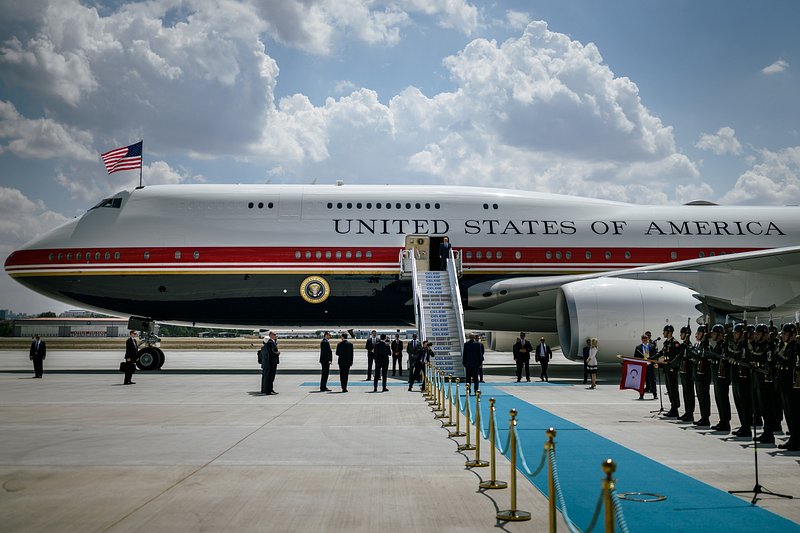
An unusual security measure aboard Air Force One has sparked speculation about President Donald Trump’s travel plans after U.S. officials reportedly confiscated reporters’ cellphones as the president departed China on Thursday.
The unexpected move came as Trump wrapped up a high-profile diplomatic visit involving Chinese President Xi Jinping and Russian President Vladimir Putin, raising questions about whether the president might be preparing for an unannounced stop before returning to Washington.
Reporters traveling with the president were instructed to surrender their mobile devices as Air Force One prepared to depart Shenzhen Bao’an International Airport.
Agence France-Presse correspondent Aurelia End confirmed the unusual development in a White House press pool dispatch.
“Our phones are being taken away for now for security reasons,” End wrote.
The directive immediately attracted attention from journalists accustomed to traveling aboard the presidential aircraft.
NBC News correspondent Garrett Haake highlighted the unusual nature of the restriction in a post on X.
“This is very unusual,” Haake wrote.
Fox News White House correspondent Jacqui Heinrich also raised questions about the president’s itinerary, pointing to another development involving a potential refueling stop in Alaska.
According to Heinrich, the combination of reporters being required to surrender their phones and the lifting of a flight restriction associated with a possible Alaska stop suggested that Air Force One “may not be heading straight home.”
The president’s publicly released schedule identified Joint Base Andrews in Maryland as his destination following the China visit.
However, it remained unclear whether Air Force One would make an additional stop before arriving in the Washington, D.C., area.
The secrecy surrounding the departure revived speculation about a possible diplomatic encounter involving North Korean leader Kim Jong Un.
🚨 UPDATE: Reporters traveling with President Trump had their phones TAKEN AWAY for “security reasons” as Air Force One left Shenzhen, China, per reports
Pool reporters say they weren’t told until they had already boarded the plane home to Washington
After three days on Chinese soil, they are not taking chances!
Pray for a safe flight home for Trump 🙏🏻
— Eric Daugherty (@EricLDaugh) November 19, 2026
Before departing Washington earlier in the week, Trump had publicly discussed the possibility of meeting Kim during his trip to China.
“We may meet with Kim Jong Un,” Trump told reporters at the White House on Monday.
The president indicated that any such meeting would take place in China and suggested that Chinese President Xi Jinping would play a role in determining whether the North Korean leader participated.
Despite those remarks, no meeting between Trump and Kim had been announced by the time the president departed China on Thursday.
There was also no official confirmation that the unusual cellphone restrictions were connected to North Korea or any other potential diplomatic engagement.
Still, the security precautions stood out because of how they differed from procedures during previous presidential travel.
Heinrich noted that journalists were allowed to retain their phones when Trump departed Beijing during a visit in May.
During that earlier trip, the White House press pool reported that American personnel discarded Chinese-issued badges and pins, along with temporary phones used by White House staff, before boarding the presidential aircraft.
Those precautions highlighted concerns about communications security during international travel, particularly when U.S. officials operate in countries where electronic surveillance is a significant consideration.
Thursday’s reported collection of reporters’ personal phones represented a different and more restrictive measure.
The departure followed an extraordinary diplomatic gathering involving the leaders of the United States, China and Russia.
Hours before boarding Air Force One, Trump participated in his first three-way meeting with Xi and Putin on the sidelines of the Asia-Pacific Economic Cooperation summit.
The discussions reportedly included nuclear arms control and the ongoing war involving Iran, placing several major international security issues at the center of the talks.
The meeting brought together three leaders whose governments play significant roles in global military affairs, nuclear policy and international diplomacy.
Access to the diplomatic discussions was tightly controlled, with several journalists reportedly prevented from attending portions of the meetings.
NBC News reported that Russian officials turned away two journalists seeking access to Trump’s separate meeting with Putin.
Chinese officials also reportedly barred Bloomberg correspondent Annmarie Hordern from attending the three-way discussions after she shouted a question concerning former Nvidia CEO Jensen Huang during Trump’s earlier meeting with Xi.
The restrictions underscored the limited access granted to journalists covering the sensitive diplomatic encounters.
During his earlier meeting with Xi, Trump commented on the press missing part of the proceedings, telling the Chinese president that it was unfortunate because “every move was perfectly executed.”
The president’s remarks came amid an itinerary involving discussions with two of the world’s most consequential geopolitical figures.
By the time Air Force One departed Shenzhen, however, attention had shifted from the meetings themselves to the unusual security procedures aboard the aircraft.
The confiscation of reporters’ phones, combined with questions about a possible Alaska refueling stop, fueled uncertainty about the president’s immediate destination.
Although Trump’s official schedule called for a return to Joint Base Andrews, the developments prompted speculation that his diplomatic trip might not yet be over.
For now, the reason for the cellphone restrictions and whether Air Force One would make an unscheduled stop remained unconfirmed.
Until the White House provides additional details, the unusual departure procedures remain a source of questions rather than evidence of a confirmed change in the president’s itinerary.

Democrate Leader Just Self-Deported After Sudden Discovery

Primetime Fox News Host Makes Shocking Admission On LIVE TV

WH Swiftly Seizes Phones On Air Force One Amidst Sudden Secret Move

Democrat Politician Indicted By Federal Grand Jury

JUST IN: Mamdani Rushed To The Hospital — Had It Coming!

Trump Sends Blunt Message To Panicked Americans Stockpiling Supplies

Massive Migrant Caravan Converges On U.S. For Democrat Midterm Victory

JUST IN: Pair Of Senior FBI Officials Arrested — It’s Damning

Pentagon Rolls Controversial Out Doomsday Strategy
Texas’ New Dem Governor Makes Horrifying Muslim Announcement

Game-Changing New Detail Emerges From Ilhan Omar Investigation

BANNED! Democrats’ First Act Should Terrify Every American
-
 Economy7 months ago
Vance Leaves Meeting, Looks Straight Into Camera, Announces Stunning Arrest
-
 Economy7 months ago
Adam Schiff Facing 30 Years In Prison After Bank Records Leak
-
 Culture5 months ago
Michelle Obama Drops Nasty Bomb About ‘Useless’ Daughter
-
 Economy7 months ago
Supreme Curt Sides With Trump — He Can Remove The All
-
 Economy8 months ago
All Hell Breaks Loose On Fox When Jesse Watters Asks Fetterman One Question
-
 Economy6 months ago
Prayers Pour In After Fox Host Dies: ‘Senseless Murder’
-
 Economy5 months ago
Pete Hegseth Just Confirmed Devastating Rumors
-
 Border & Security4 months ago
Top Trump Admin And Wife Found Dead — Chilling Update Just Released