
Latest
Reporter’s Notebook: GOP clash over ‘skinny’ vs ‘obese’ DHS bill as Trump agenda looms

If it’s up to top Senate GOP leaders, the next budget reconciliation package to finally fund the Department of Homeland Security will be on a fiscal cocktail of Wegovy and Ozempic.
But other Republicans want this measure to be a high-calorie, political feast. Pop-Tarts, Sour Cream and Onion potato chips from Pringles, topped with Reese’s Pieces and a side of Häagen-Dazs chocolate peanut butter ice cream. All washed down with an entire two-liter of Mountain Dew.
Stymied by Democrats — and in many cases themselves — congressional Republicans are now teeing up a reconciliation package to end the two-month-long DHS funding stalemate. By using budget reconciliation as a tool, Republicans can ignore Democrats, sidestep a Senate filibuster and prospectively pass the bill on their own.
If they all stick together.
GOP INFIGHTING REPLACES CLASH WITH DEMS, DERAILS PATH TO END HISTORIC DHS SHUTDOWN
There’s a push by Senate Majority Leader John Thune, R-S.D., to prep a bill as svelte as possible, since DHS has been penniless for so long.
“We’re going to move quickly, decisively, and hopefully in a very focused way,” said Thune.
This is why Republicans call this a “skinny” bill, devoted to ending the shutdown.
“We want to fund ICE and Border Patrol and maybe a few other things. But very narrow. Very focused,” said Senate Budget Committee Chairman Lindsey Graham, R-S.C.
But not everyone in the Senate Republican Conference is on parliamentary Weight Watchers.
Some want to stuff the reconciliation bill with tens of billions of dollars to cover the cost of the war in Iran. Others want to include the touchstone of Trump’s legislative agenda, the SAVE America Act. It requires proof of citizenship in order to vote. There’s a push to tack on farm aid. Others are arguing for disaster relief.
HOUSE CONSERVATIVES RAGE AGAINST SENATE DHS SHUTDOWN DEAL
“It doesn’t need to be skinny. We need to do the SAVE America Act. We need to fund the war. We need to do whatever President Trump needs to do with DHS and TSA,” said Sen. Tommy Tuberville, R-Ala., on Fox Business. “Let’s put as much stuff in there as we can get now.”
But loading up the bill could slow it down. Especially when time is of the essence.
“The broader you make this, the longer it’s going to take to pass the bill,” yours truly pointed out to Sen. Bill Hagerty, R-Tenn.
“That’s a fair assumption,” replied Hagerty. “But we have some critical needs as well. We’re going to have to debate all of this and decide exactly how far we’re going to go. Speed is critical.”
I asked Thune if he was “worried” that some Republican senators may ask to dump “other things” into the legislation.
“Well, they could,” replied Thune. “We have members who want other things. I mean, I want other things. But obviously we have a specific mission and purpose here.”
Sen. John Kennedy, R-La., opined on what skinny or fat means for the fate of the legislation.
“If John [Thune] holds firm, then the bill will remain skinny. If he doesn’t, it’ll jeopardize the bill being passed,” said Kennedy. “If he starts making deals, there will be four or five senators who take a run at it to try to have their stuff included. If he starts making deals to get their votes, it’ll be a huge mistake because you’re talking to one senator, and he is going to insist that [his] stuff be included, too.”
Kennedy called adding legislative sweeteners — increasing the political caloric count — into the legislation to convince reluctant senators to vote yes would be “a huge mistake.” Kennedy noted that “this skinny bill is going to become obese very quickly.”
So adding Iran dollars into the bill is one option, but some Republicans are reluctant to spend any more money on Iran until they get some answers about what’s next.
“It’s going to be very difficult to get my support for any funding, or any additional resources from Congress until I have a clear, articulated strategy, how this is going to be ramping down over the next 60 or 30 to 35 days. Or, if it’s going to be escalated,” said Sen. Thom Tillis, R-N.C. “We need a clearly articulated plan if we’re going to be there for the long term.”
‘WE DIDN’T CAVE’: THUNE HIGHLIGHTS SCHUMER, DEMS’ LOSSES IN DHS FUNDING DEAL
Other Republicans are willing to give the administration some leeway on Iran.
“We can’t control the time it’s going to take to accomplish the mission. So the mission should be the goal. Not the time it takes to accomplish the goal. We’re in it. We need to be in it to win it,” said Sen. Cynthia Lummis, R-Wyo. “Look at Vietnam. The reason we lost is because that war was being managed by LBJ from the White House. And when the White House tries to manage the military and call the shots and make the day-to-day decisions, we fail.”
This is an apples-and-oranges question, but some Republicans are not-so-quietly getting skittish about how long the U.S. will be on the hook for the war. Especially as the conflict creeps toward the 60-day mark later this month.
“I think it will be solved by then,” said a confident Sen. Bernie Moreno, R-Ohio.
But even if the battle is over, it’s probable the U.S. would still maintain military assets in the region. There’s a running cost on that. That bill will come due at some point. And that’s why this reconciliation bill is such a ripe target for additional items like Iran war funding.
But Republicans are already promising an additional reconciliation bill. If the first bill remains lean, GOPers will inevitably push to stash whatever they can in the later package. Still, that’s hard. And with DHS unfunded for so long, that’s why Thune is trained just on approving DHS money.
But reconciliation bills are complex. The House and Senate consumed the entire period from early February through July 3 last year just to pass the One Big, Beautiful Bill Act. Thune and the president want the DHS funding bill wrapped up in the next few weeks. So a third bill?
“Those who tell us that we’re going to have a third reconciliation bill have been smoking the devil’s lettuce. We will never have a third reconciliation bill,” said Kennedy. “This is the last major piece of legislation that we will likely pass until the midterms. There’s a feeling which I share among the Senate caucus that this is the last train leaving the station. We had better get all our cargo aboard. Now.”
Most diets fail. It’s not a question of willpower. But sometimes dieting is a challenge the deeper you get into it.
The House and Senate are just beginning the current effort to pass the reconciliation bill for DHS funding. It may start out slender, but maintenance is hard.
Here’s something else working against lawmakers: history.
Congress is used to piling lots of things into “must-pass” bills. That’s where the extra parliamentary pounds come from.
Diets often succeed because someone makes lifestyle changes. Will Congress make a “lifestyle change” and pass a reconciliation that only ends the DHS shutdown?
It’s a weighty question.

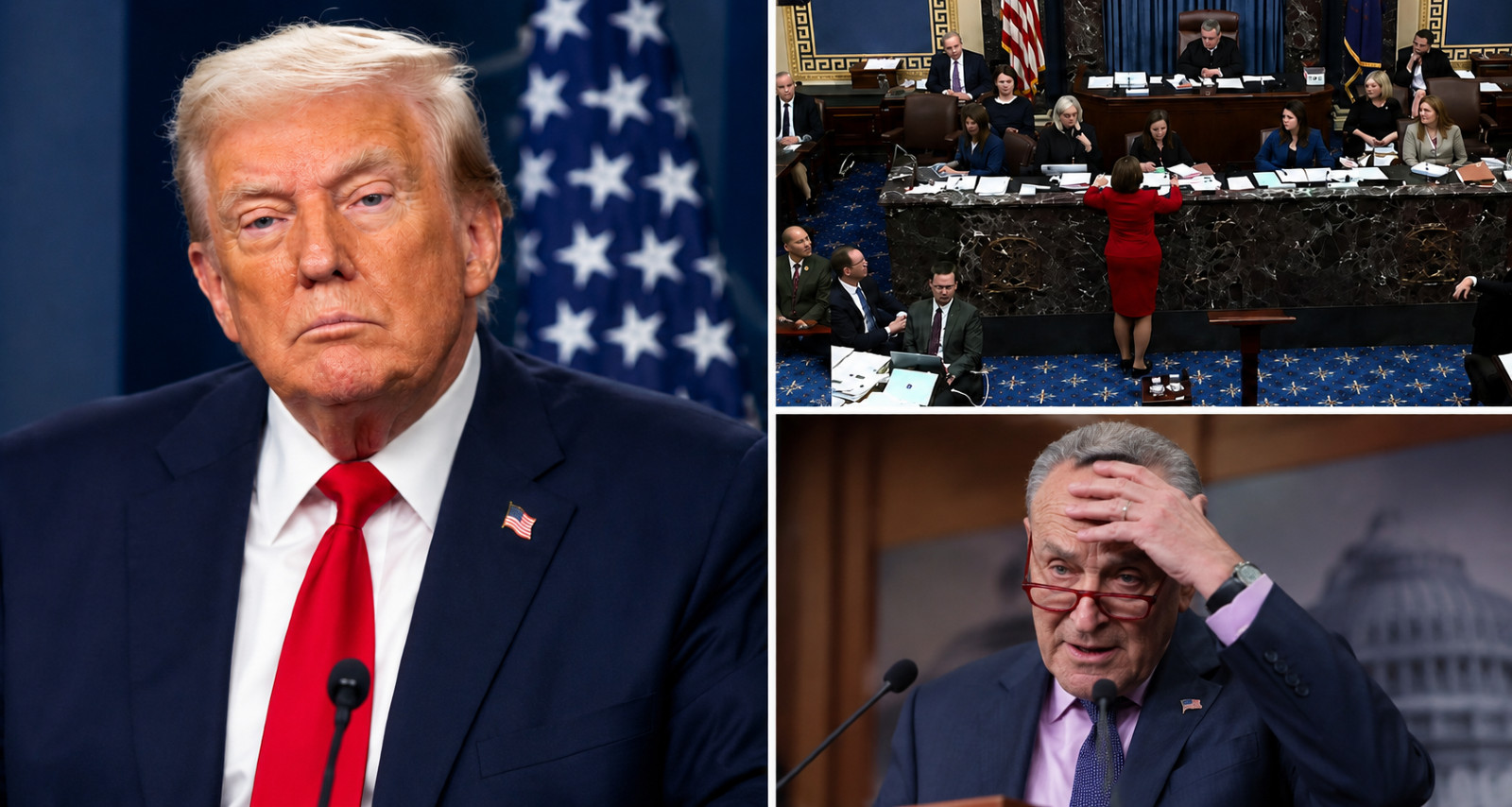
Senate Republicans narrowly defeated another Democratic attempt to limit President Donald Trump’s authority over ongoing U.S. military operations involving Iran, preserving the administration’s flexibility as fighting in the region continues to intensify.
In a razor-thin 50-49 procedural vote, Republicans blocked Democrats’ latest effort to force immediate congressional action on U.S. troop deployments. The measure sought to discharge a war powers resolution from the Senate Foreign Relations Committee and bring it directly to the Senate floor for a vote.
It marked the thirteenth time Democrats have attempted to curb the president’s military authority over Iran.
Three Republicans—Sens. Susan Collins of Maine, Lisa Murkowski of Alaska, and Rand Paul of Kentucky—joined most Democrats in supporting the effort.
But Sen. John Fetterman, D-Pa., once again broke with his party, becoming the lone Democrat to oppose the resolution and providing Republicans with the decisive vote needed to keep the measure from advancing.
The outcome marked the eleventh time Republicans have successfully blocked similar efforts, highlighting both Democrats’ determination to challenge the administration’s military strategy and the GOP’s ability to hold the line when its members are present.
The vote came against the backdrop of rapidly escalating events overseas.
Earlier that same morning, U.S. Central Command confirmed strikes against Iranian military command centers and missile sites, although officials did not disclose the exact locations or casualty figures.
At nearly the same time, drones believed to be launched by Iran struck vessels at an Egyptian port near the Suez Canal, setting two ships on fire and raising new concerns about Tehran’s ability to threaten one of the world’s busiest commercial shipping corridors.
Those developments dominated debate on the Senate floor, where Democratic Leader Chuck Schumer argued that Congress should intervene.
“This aimless war has been one of the biggest catastrophes in American history. Trump’s mess only gets worse with every passing hour. Trump said this war would last a week, but American service members are still getting killed five months later,” Schumer added.
Schumer also pointed to the reported attack in Egypt as evidence that the conflict is broadening.
“This war seems to be expanding with Iran’s latest attack in Egypt’s territory. Senate Republicans cannot sit on the sidelines as Trump’s war escalates out of control,” Schumer added.
Supporters of the administration counter that congressional intervention at this stage would undermine ongoing diplomatic efforts and weaken America’s negotiating position.
President Trump previously argued that a similar Senate vote in June “made his job more difficult” as his administration pursued negotiations aimed at de-escalating the conflict.
Republicans have maintained that ordering troop withdrawals while military operations and diplomatic talks remain active would reduce American leverage, embolden the Iranian regime, and place U.S. service members already deployed in the region at greater risk.
The June 23 vote remains the only instance in which Democrats successfully advanced a related nonbinding concurrent resolution.
That measure passed the Senate after Republican Sens. Dave McCormick of Pennsylvania and Mitch McConnell of Kentucky were absent.
Trump later dismissed the resolution as “poorly timed and meaningless,” noting that it carried no binding legal effect.
Tuesday’s vote reinforced Republican leaders’ argument that, with a full conference in attendance, they can continue protecting the commander-in-chief’s authority to direct military operations without additional congressional restrictions.
Fetterman’s willingness to repeatedly break with fellow Democrats on Iran-related votes has also become increasingly notable.
Without his vote, Democrats would have prevailed 50-49, allowing the resolution to move forward.
Instead, his decision once again provided the margin Republicans needed to preserve the administration’s operational flexibility.
The dispute reflects a broader constitutional debate over war powers that has existed for decades.
Democrats argue that Congress—not the executive branch—must reassert its Article I authority over military engagements they believe have not received sufficient congressional authorization.
Republicans, meanwhile, contend that imposing legislative constraints while military operations remain underway and diplomatic negotiations continue would project weakness to America’s adversaries and increase risks for U.S. forces already operating in the region.

A Department of Homeland Security special agent is accused of fatally shooting his wife before turning the gun on himself in a tragic murder-suicide that has stunned a New Jersey community and prompted an ongoing investigation.
Authorities say Christopher Latauro, 52, and his wife, Kelly Latauro, 46, were found dead at their Sayreville home on July 3 after police responded to a residence on Glynn Court at approximately 8 p.m.
According to the Middlesex County Prosecutor’s Office, officers discovered Kelly Latauro dead inside the home while Christopher Latauro was found dead in the backyard. Both suffered apparent gunshot wounds.
Investigators believe Christopher Latauro shot his wife before taking his own life. Officials continue to investigate the case as a murder-suicide.
As detectives processed the scene, police closed Glynn Court between Deerfield Road and Scarlet Drive before reopening the roadway roughly 40 minutes later. Investigators, however, remained at the residence for several hours gathering evidence.
According to NJ101.5, citing Department of Homeland Security records from 2019 and 2020, Christopher Latauro served as a special agent with the agency.
Authorities have not publicly identified a motive for the killings.
The loss has devastated family members, including Kelly Latauro’s sister-in-law, Robyn Perlman-Spencer, who shared an emotional tribute on Facebook days after the tragedy.
“As many of you may now know, my beautiful sister-in-law Kelly Latauro was senselessly and suddenly taken from us on Friday,” she wrote.
“Kelly was a bright light—kind, thoughtful, hysterical, inappropriate, and just one of the most amazing people I’ve ever known,” the post noted further.
Sayreville police confirmed officers responding to the home found both individuals dead from gunshot wounds, while the Middlesex County Prosecutor’s Office continues to lead the investigation.
The tragedy comes as the Department of Homeland Security is simultaneously taking a far more aggressive role in another high-profile issue: election security.
Homeland Security Secretary Markwayne Mullin recently warned that election officials who refuse to cooperate with the administration’s election integrity initiatives could face significant penalties, including criminal prosecution.
Speaking at the Eisenhower Executive Office Building, Mullin said officials who ignore federal guidance after receiving information needed to secure their election systems could be held personally responsible.
“If the election officials, once we gave them the information they need to secure their elections — and they chose not to — then those individuals can also be held accountable by fines, by penalties, and even, depending on how far it goes, prison time,” Mullin said.
Mullin also announced that DHS will accelerate election security efforts nationwide and suggested certain federal election security grants could be withheld from states that decline to implement administration-backed safeguards. Among those measures is the use of the Systematic Alien Verification for Entitlements (SAVE) system to help identify potential non-citizens on voter registration rolls.
His remarks followed President Donald Trump’s recent address on election security, during which the president highlighted concerns about election infrastructure, foreign cyber threats, and the integrity of voter registration systems.
The Justice Department has likewise begun increasing pressure on states, sending letters to election officials warning that failure to remove ineligible non-citizens from voter rolls could result in legal action.
According to Mullin, 23 states are already partnering with DHS to review voter registration records using federal immigration databases.
The secretary also blasted legal challenges that recently blocked the administration from creating a database containing Americans’ Social Security numbers, citizenship status, and other personal information, arguing those lawsuits have slowed efforts to strengthen election security.
Meanwhile, President Trump continues to push Congress to pass the SAVE America Act, legislation designed to tighten election integrity standards by requiring proof of citizenship and government-issued identification for voting, among other reforms. The measure has remained one of the president’s top legislative priorities over the past year.
With the 2026 midterm elections drawing closer, Republicans believe the legislation now has its best opportunity yet to become law, although Vice President JD Vance may ultimately be called upon to cast a tie-breaking vote if the Senate divides evenly.
Sen. John Hoeven, R-N.D., said Senate Republicans are working through the weekend to restructure the SAVE America Act so it can advance through the budget reconciliation process, allowing the legislation to pass with a simple majority instead of the 60 votes typically required to overcome a filibuster.
Appearing on Newsmax’s “Saturday Agenda,” Hoeven said the House-approved budget resolution provides Republicans with a procedural pathway to bypass the filibuster, provided the bill’s voter identification provisions satisfy Senate reconciliation rules and survive review by the Senate parliamentarian.

New York City Mayor Zohran Mamdani is facing criticism after urging residents to protest Israeli Prime Minister Benjamin Netanyahu during his visit to the city, with police advocates warning that the move could create additional security challenges for an already stretched NYPD.
Critics argue that Mamdani is approaching the situation more like a political activist than the leader of the nation’s largest city, saying his public call for demonstrations could make an already demanding job even more difficult for law enforcement.
The mayor’s comments come after an especially busy stretch for the NYPD, which has spent weeks providing security for several major events, including the FIFA World Cup, Independence Day celebrations, and the America 250 festivities that brought millions of visitors into New York.
Police supporters say encouraging another large demonstration only adds pressure to officers who have already been working extended hours.
“The mayor’s activist posturing puts police officers on the street in a terrible position,” NYPD Police Benevolent Association President Patrick Hendry said, per the New York Post.
“Protests during the UN General Assembly are nothing new, but when the mayor of the city is actively calling for demonstrations, violent agitators will assume they have permission to cause as much havoc as possible,” he added.
“Those same agitators know that the NYPD’s protest response is already hamstrung by the dangerous lawsuit settlement the city signed over the PBA’s opposition,” said Hendry.
“The mayor’s heated rhetoric could be enough to push demonstrations over the edge into chaos.”
Mamdani has been an outspoken critic of Netanyahu since before launching his successful mayoral campaign. His criticism of Israel has drawn sharp backlash from opponents, some of whom have accused him of promoting anti-Israel rhetoric that crosses into anti-Semitism.
During the campaign, Mamdani pledged that he would seek to have Netanyahu arrested if the Israeli leader traveled to New York, referencing the International Criminal Court’s 2024 warrant alleging war crimes in Gaza.
This week, however, the mayor acknowledged that he does not possess the legal authority to carry out such an arrest.
Instead, Mamdani encouraged New Yorkers who oppose Netanyahu’s visit to exercise their First Amendment rights by demonstrating publicly, a decision critics say will require additional police resources for crowd control and security.
“This is a city where, if anyone feels a level of frustration or opposition, protest is something that we will always respect,” Mamdani told reporters at City Hall this week.
“That New Yorkers can express themselves, whether they are in support or in opposition, no matter on whatever topic,” he said.
“And I’ve always said that when we respect our Constitution, we also respect our First Amendment,” he claimed.
The mayor’s comments come just as the NYPD is recovering from one of its busiest summers in recent memory. Officers worked 12-hour shifts for weeks while policing massive crowds during international sporting events and national celebrations, completing those assignments without major incident.
Now, some officers fear another wave of demonstrations will place unnecessary strain on an already exhausted force.
“Was he serious?” one incredulous Manhattan cop asked The Post.
“Cops just came off a crazy six weeks between the Knicks and the World Cup working long hours every day, and now he’s going to subject them to unnecessary problems,” the officer added, per The Post.

All Hell Breaks Loose In Senate After Wild Vote — It’s Shut Down!

Top Trump Admin And Wife Found Dead — Chilling Update Just Released

Mayor Mandami Enraged — NYPD Defies Him Over Insane New Order

Tucker Carlson Officially Makes Shock Announcement — He’s Out

Top Fox News Host Suffers Deranged Meltdown On LIVE TV — Doesn’t End Well…

It’s Over! The House Votes 396-13 — Trump Just Won!
Mayor Mandami Enraged — NYPD Defies Him Over Insane New Order
Top Trump Admin And Wife Found Dead — Chilling Update Just Released
All Hell Breaks Loose In Senate After Wild Vote — It’s Shut Down!
-

 Economy4 months ago
Vance Leaves Meeting, Looks Straight Into Camera, Announces Stunning Arrest
-
 Economy4 months ago
Adam Schiff Facing 30 Years In Prison After Bank Records Leak
-

 Economy4 months ago
Supreme Curt Sides With Trump — He Can Remove The All
-
 Economy4 months ago
All Hell Breaks Loose On Fox When Jesse Watters Asks Fetterman One Question
-

 Economy2 months ago
Prayers Pour In After Fox Host Dies: ‘Senseless Murder’
-

 Economy4 months ago
NBC Stops LIVE Broadcast — Breaks Big Trump News
-

 Economy4 months ago
Trump Pulls Off Miracle Of A Lifetime — It’s Permanently Open
-

 Culture2 months ago
Michelle Obama Drops Nasty Bomb About ‘Useless’ Daughter