
Latest
Shots Fired — Trump Just Issues Scathing Warning, It’s Going Down!

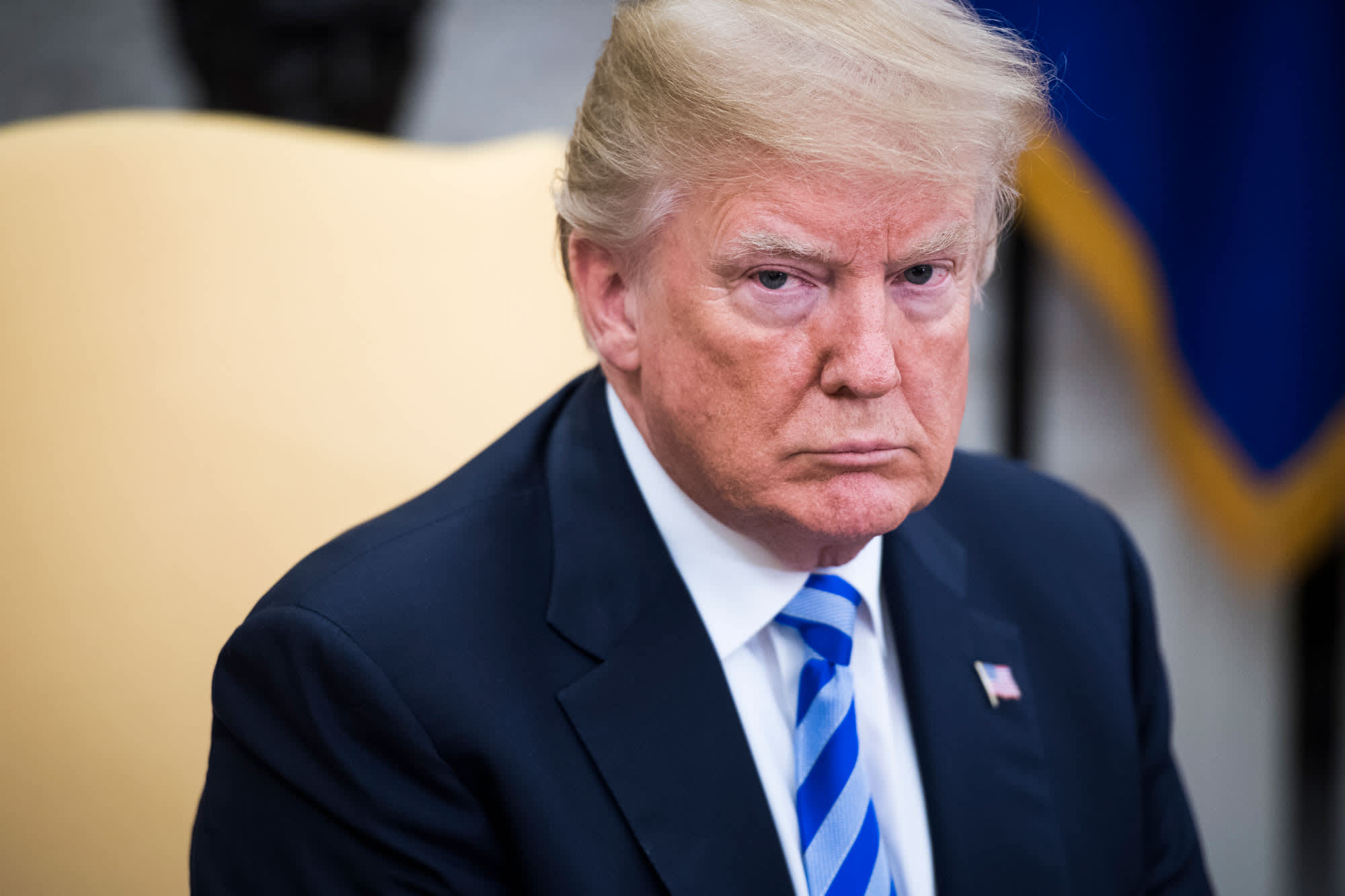
Few places on the planet matter more to the global economy than the Strait of Hormuz.
That’s why President Donald Trump has given Iran until Tuesday to allow all vessels through the key waterway — or face strikes on critical infrastructure, as fuel costs climb worldwide.
In a profanity-laced post on Truth Social, Trump wrote on Sunday: “Tuesday will be Power Plant Day, and Bridge Day, all wrapped up in one, in Iran. There will be nothing like it!!! Open the F—–’ Strait, you crazy b——-, or you’ll be living in Hell – JUST WATCH! Praise be to Allah.”
“Tuesday, 8:00 P.M. Eastern Time!” he wrote in a second post.
Trump also said he will hold a press conference at the White House on Monday alongside military officials.
SAN FRANCISCO BECOMES FIRST US CITY WHERE DIESEL PRICES TOP $8 A GALLON
At just 21 miles wide at its narrowest point, the waterway between Iran, Oman and the United Arab Emirates is one of the world’s most critical energy choke points. It carries roughly 20 million barrels of oil a day, along with about one-fifth of global liquefied natural gas.
It’s also a key artery for refined fuels. The Middle East exports about 1.1 million barrels per day of jet fuel — roughly 15% to 17% of global consumption — according to Jaime Brito, executive director of refining and oil products at OPIS. Much of that supply moves through the Strait of Hormuz.
The escalation is already sending oil, gasoline, diesel and jet fuel prices sharply higher worldwide.
As of April 5, the national average for regular gasoline stood at $4.11 per gallon, according to AAA — up 86 cents from a month earlier. On the West Coast, drivers are seeing the highest costs, with prices reaching $5.92 per gallon in California and $5.37 in Washington.
WHERE GAS PRICES ARE RISING FASTEST AS TRUMP ISSUES FRESH WARNING TO IRAN
On the East Coast, gas prices are exceeding $4 in several areas, including $4.27 in Washington, D.C., and $4.06 in New York.
In the Midwest, Illinois stands out at $4.29 per gallon, while much of the region remains in the mid-$3 range. Southern states remain cheaper overall, though prices are rising. Texas and South Carolina are averaging $3.82, while Florida is higher at $4.20.
Diesel has climbed to $5.61, up about $1.45 over the past month. As a key fuel for freight, shipping and public transportation, it is especially sensitive to supply disruptions.
In San Francisco, prices have surged even higher. For the first time on record, average diesel costs have surpassed $8 per gallon, according to GasBuddy — an unprecedented milestone for any U.S. city.
Additionally, jet fuel prices in the U.S. have more than doubled in a matter of weeks as Middle East tensions squeeze supply.
THE UNLIKELY TOOL TRUMP IS EYEING TO TACKLE RISING OIL PRICES AMID THE IRAN CONFLICT
Prices jumped from about $2.11 in January to $4.88 per gallon by April 2, according to the Argus U.S. Jet Fuel Index, a daily benchmark tracking prices in Chicago, Houston, Los Angeles and New York.
Jet fuel — one of airlines’ largest expenses — is especially volatile due to thin inventories, specialized storage and limited spot trading. That can amplify price swings when supply tightens.
Airlines have warned that inventories could run dry within weeks, raising the risk of higher airfares and flight cancellations.

Every politician eventually runs out of other people’s money to spend. Blue state governors and legislators are just running out faster than the rest.
Right now, there is a coordinated wave of new tax proposals sweeping California, New York, Washington state, Massachusetts, Michigan and Connecticut. The common thread? They all believe the solution to self-inflicted budget crises is to reach deeper into the pockets of their most productive residents. And if those residents decide to leave, they want to charge them an exit tax on the way out. What? Is this America?
Let that sink in. An exit tax. As in, we know you’re leaving because of our lousy tax structure, and we want the door to hit you on the way out.
CALIFORNIA’S HATRED FOR CAPITALISM IS KILLING THE GOOSE THAT LAID ITS GOLDEN EGG
The proposals on the table right now
California’s Billionaire Tax Act is the crown jewel of this movement. The ballot measure would impose a one-time 5% tax on the total net worth of anyone worth more than $1 billion residing in the state. Not their income. Their net worth. Think about what that means for a founder whose entire net worth is locked up in a private company that employs thousands of people. And think about how many millionaires they made themselves building that company. You could have $2 million in liquid assets, and a $100 billion paper valuation and California would hand you a $5 billion tax bill. That’s not a tax policy. That’s an asset seizure dressed up as fairness.
Washington state, which has never had an income tax in its history just passed a 9.9% tax on incomes over $1 million. The moment that bill cleared the legislature, Starbucks founder Howard Schultz announced he was moving to Florida. Shocker. Starbucks’ own headquarters announced it’s moving to Tennessee. Shocker. When the founder and the company both leave at the same time, that’s not a coincidence. That’s a message we hear in a resounding fashion from high tax high spend states.
Michigan wants to amend its state constitution to impose a 9.25% top rate on incomes over $500,000. For residents of Detroit, the combined state and local rate would approach nearly 12%. Meanwhile, across the border in Ohio, the flat income tax rate is 2.75%. In Indiana, it’s 2.95%. You don’t need to be a certified financial planner to do that math. You just need a moving truck.
SEAHAWKS GM WARNS WASHINGTON’S NEW ‘MILLIONAIRE TAX’ COULD HURT FREE AGENT RECRUITING
This is a story about bad leadership decisions
I want to be clear about something. I’m not here to defend billionaires. I’m here to defend economic reality.
The top 1% of California taxpayers currently supplies nearly half of all income tax collections in the state. Half. That’s not a sustainable revenue model. That’s a house of cards. And the moment those top earners which are not just the billionaires, but when the $500,000-a-year business owners, the startup investors, the executives start relocating, the math collapses for everyone else who stays behind.
MAMDANI’S ESTATE TAX PLAN COULD DRIVE WEALTH OUT OF STATE, CRITICS WARN
This has already started. Six of California’s 214 billionaires left before the proposed January 1, 2026, residency cutoff. Those six people alone took $27 billion in potential tax revenue with them. Google co-founder Larry Page dropped $170 million on a Miami estate and moved his family office out of California. David Sacks who lived 30 years in the state packed up for Texas and called the proposed tax what it really is which is an asset seizure.
Here’s what I’ve learned in over thirty years as a financial advisor. Wealthy people don’t wait for the bill to arrive. They plan years in advance. The exits happening today were decided in law offices and financial planning meetings 18 months ago. The exits that haven’t happened yet are being decided right now.
Why this should matter to you even if you’re not a billionaire
WASHINGTON DEMS PASSED AN INCOME TAX THEY KNOW IS UNCONSTITUTIONAL. THAT WAS THE POINT
Here’s where this stops being an abstract policy debate and starts affecting your daily life.
When high earners leave a state, the remaining tax base must pick up the tab. Services get cut. Or taxes get raised on the next rung of earners which are the people making $150,000, then $100,000, then lower. California, New York, and Michigan didn’t build world-class universities, hospitals, and infrastructure by accident. They built them on the backs of a thriving private economy. Dismantle the engine, and eventually the whole train stops.
There’s also a broader economic signal being sent here. When Washington state is no longer a zero-income-tax state, when California makes it financially dangerous to be a successful founder, and when Michigan punishes its highest earners at nearly 12 cents on the dollar innovation, capital, and job creation go somewhere else. And somewhere else, right now, is Florida, Texas, Tennessee, and Nevada.
CALIFORNIA’S LOOMING CAPITAL FLIGHT PROBLEM COULD RESHAPE STATE IN 3 KEY AREAS
What you should do right now
If you live in one of these states and you have built meaningful wealth including a business, a portfolio, a real estate holding, or a qualified retirement account this is not a news story to skim and forget. This is a planning conversation to have with your financial advisor and your estate planning attorney. Several of these proposals include exit taxes on residents who leave within five years of implementation. The window to plan proactively is now. Not after the ballot measure passes. Not after the bill is signed. Now.
Wealthy people are not a fixed resource. They are mobile, they are organized, and they have options.
And right now, those options are looking a lot like the Sunshine State instead of the Golden State.
A party-line tactic to ram legislation through Congress and bypass the Senate filibuster has become a dumping ground for Republicans’ legislative priorities throughout the year.
Now, as Democrats refuse to fund immigration operations, Republicans are once again readying a budget reconciliation package. The hard part will be getting enough of the GOP on the same page to craft a bill that can pass and survive the strict rules underpinning the process.
Republicans used the same process to pass President Donald Trump’s “big, beautiful bill” last year. It’s a time-consuming, labor-intensive legislative maneuver that nearly blew up and could fail unless both the Senate and House align on what exactly they want to include.
SENATE PASSES BILL TO FUND MOST OF DHS AFTER HOUSE GOP CAVES
Trump officially backed using reconciliation again this week as a way to skirt Democrats’ refusal to fund Immigration and Customs Enforcement (ICE) and Customs and Border Protection (CBP), as Congress inches closer to ending the ongoing Department of Homeland Security (DHS) shutdown.
Trump demanded that Republicans get the bill on his desk by June 1.
“We are going to work as fast and as focused as possible to replenish funding for our Border and ICE agents, and the Radical Left Democrats won’t be able to stop us,” Trump said on Truth Social.
Still, Republicans have viewed reconciliation as a vehicle to tackle fraud, affordability, Trump’s tariff authorities, additional tax provisions, healthcare, funding for the Iran war, supplemental agriculture spending, and election integrity measures in the months since passing the “big, beautiful bill.”
DHS SHUTDOWN BREAKTHROUGH COMES AT COST FOR REPUBLICANS AS FUNDING FIGHTS NEARS END
Senate Majority Leader John Thune, R-S.D., has warned that if reconciliation is going to work — especially given the limited timeframe lawmakers have to start and finish the process — Republicans need to “keep our expectations realistic.”
“Our theory of the case behind all this was to keep that thing as narrow and focused as possible, and that maximizes the speed at which we can do it and the support for it,” Thune said.
“There will probably be some attempts to add things,” he continued. “There are things out there that, obviously, many of us are interested in. But on a reconciliation vehicle like this — which we need to move with haste, as the president has pointed out — it’s probably not a likely magnet for all these other issues.”
Senate Budget Committee Chair Lindsey Graham, R-S.C., told voters at an event this week in South Carolina that he is eyeing two new reconciliation packages, which could ease concerns about cramming all the GOP’s priorities into one massive bill.
GOP RAILS AGAINST ‘S— SANDWICH’ DEAL AS ALL EYES TURN TO HOUSE TO END DHS SHUTDOWN
“We want to do it quick — ICE, Border Patrol — fund it as much as you can, multi-year,” Graham said. “Then there’s another one coming. I just made news. There’s another one coming in the fall, and that’s going to be about going after fraud.”
House Republicans spent their recent policy retreat earlier this year pushing a so-called “reconciliation 2.0,” gearing up to load the package with several provisions that could drain time and struggle to earn support in the Senate — where strict guidelines could kill proposals entirely if they don’t comply with the rules.
The Republican Study Committee (RSC), which has long called for a second reconciliation bill, also wants to add proposals addressing affordability concerns.
“We support pursuing funding for military readiness and Homeland Security through this legislative process, while simultaneously codifying the president’s agenda to deliver lower costs for working families,” the RSC Steering Committee said in a statement to Fox News Digital.
Some Republicans are also pushing to include the latest policy fight: the Safeguarding American Voter Eligibility (SAVE) Act. The voter ID and citizenship verification legislation has no chance of passing the Senate given unified Democratic opposition.
It’s also unlikely to survive the Senate’s reconciliation rules, which allow only provisions that directly impact spending.
“I think we have to set our sights a little bit lower on this reconciliation bill,” Sen. Roger Marshall, R-Kan., told Fox News Digital. “It’s got to be targeted to fund ICE for 10 years — I think that’s the number one thing for us. If we can nibble at the edges of the SAVE Act, that would be great, but the parliamentarian is not going to let us do the SAVE Act. That’s just an impossibility.”
Some of the loudest proponents of the bill in the House GOP acknowledge that adding the SAVE Act to reconciliation would be a challenge — largely because they would prefer to keep the bill intact and push it through the Senate.
“Look, it’s time for them to do a walk-and-talk and filibuster, and let’s make this thing happen,” Rep. Ralph Norman, R-S.C., said. “The American people are watching — piecing it together just to try to get a piece.”
Latest
Trump fighting fierce battles, at home and abroad: Why he casually dismisses the consequences
Donald Trump is waging a two-front war.
In Iran, the downing of an American F-15 fighter jet, with the spectacular rescue of the missing second crew member, announced by the president yesterday, was fantastic news thanks to special ops teams who risked their lives to find him. But the fact that the plane was shot down unfortunately undercuts Trump’s argument that the murderous mullahs have no ability to fight back. And it highlights what soldiers have always known: War is hell.
The same goes for the Iranians downing an A-10 attack plane, and though the pilot was quickly rescued, it shows the unpredictable nature of war.
At home, Trump has been firing top aides, and targeting others for dismissal. The ouster of Pam Bondi and Kristi Noem, and media reports about who’s next, has fueled anxiety throughout the Cabinet. The only person who’s probably safe at this point is Jared, given his son-in-law status.
WHY TRUMP’S WAR SPEECH FAILED: DECLARING VICTORY BUT STILL BOMBING IRAN BACK TO THE ‘STONE AGES’
There is some connective tissue between these ongoing battles. They reflect a president who busts through the guardrails, scolds his allies, launches a surprise war with little explanation, and turns on those he deems insufficiently loyal.
To his supporters, Trump gets results because he’s not afraid to take risks that have paralyzed previous presidents grappling with the world’s leading terror state.
To his detractors, Trump is impulsive and reckless, boxing himself into impossible corners by failing to adequately plan for the inevitable consequences.
WHY TRUMP FACES AN AGONIZING DECISION ON OBLITERATING IRAN’S OIL SUPPLY IF HE CAN’T GET A DEAL
By any fair yardstick, U.S. and Israeli warplanes have decimated Iran’s military machine with a remarkably low casualty rate.
And Iran’s cheap-to-produce drones have caused some injuries to Americans at military bases in surrounding Arab countries, and also inflicted damage on Israel, wounding numerous residents.
Asked by NBC’s Garrett Haake in a phone call whether the downing of the F-15 – before the rescue – would affect his negotiations with Iran, Trump said, “No, not at all. No, it’s war. We’re in war, Garrett.”
One reason the president’s prime-time speech fell short is that the public expected him to declare victory and get out, not threaten to bomb Iran “back to the Stone Ages.” And will he actually wrap things up in “two to three weeks,” which is his standard refrain for some time in the future?
For the president to urge European nations to just “take” the Strait of Hormuz – after having declared that he wouldn’t end the war without a deal to break the Iranian blockade – shows the mixed messages that have marked this conflict.
And then, having washed his hands of anything having to do with Hormuz, Trump posted on Truth Social yesterday: “Open the F—– Strait, you crazy b——s.”
Uh, which is it? Depends on when you ask him. (CNN ran the quote as a banner, uncensored.)
TRUMP VOWS US WILL STRIKE IRAN’S POWER PLANTS, BRIDGES IF STRAIT OF HORMUZ IS NOT REOPENED
Trump is touting Iran’s parliament speaker, Mohammad Ghalibaf, as someone he can do business with. But Ghalibaf has repeatedly mocked him, posting: “This brilliant no-strategy war they started has now been downgraded from ‘regime change’ to ‘Hey! Can anyone find our pilots? Please?’”
Perhaps the president will lose confidence in him the way he did with Pam Bondi.
The now-former attorney general did a terrible job, from botching the Epstein files to refusing to engage with the pedophile’s victims to insulting Democrats at a hearing in which she proudly proclaimed that this was a distraction from the Dow topping 50,000.
Bondi unloaded on Jamie Raskin, who led Democrats during Trump’s second impeachment: “You don’t tell me anything, you washed-up loser lawyer. You’re not even a lawyer!?” (Raskin is a graduate of Harvard Law School and taught constitutional law at American University.)
But that only partially explains her removal. Bondi did everything she could to prosecute Trump’s political enemies. But charges against James Comey and Letitia James were tossed out by judges or blocked by grand juries that refused to indict.
It’s worth dwelling on how outrageous it is for the Justice Department to serve as an attack dog for those who the president has pronounced guilty. Not since John Mitchell went to prison in the Watergate coverup has the department’s mission been so twisted.
Bondi’s likely replacement, Todd Blanche, Acting Attorney General, a former Trump defense lawyer (and ex-prosecutor), backed Bondi every step of the way in turning DOJ into Trump’s Department of Retribution. The president clearly wants Blanche to be even more aggressive.
Trump all but confirmed this yesterday to ABC, saying: “Everybody wants it. But Todd’s doing very well. He’s been with me a long time.”
PAM BONDI IS OUT AS AG — HERE ARE THE CONTENDERS WHO COULD REPLACE HER
Trump’s attorneys general have suffered the same fate. He booted Jeff Sessions for recusing himself from the Russiagate probe, and then campaigned against him. Bill Barr resigned under pressure from Trump after finding no widespread fraud in the 2020 election, with the president later hurling insults at him.
Noem also did an awful job, seemingly more interested in self-promotion than dealing with the excesses of ICE, especially the fatal shooting of two American citizens, who she branded domestic terrorists. It wasn’t until she falsely accused Trump of approving a costly ad campaign featuring her that he’d had enough.
As an added indignity, we learned that Noem had potentially exposed herself to blackmail when those gaudy photos of her cross-dressing husband surfaced.
Now there are newspaper reports that Trump may dump Labor Secretary Lori Chavez-DeRemer, who’s been accused of an improper relationship with a security staffer, misusing public funds and workplace drinking. Several top aides have resigned, and her husband is barred from the building after an accusation of sexual assault.
Trump is also weighing a pink slip for Commerce Secretary Howard Lutnick, who often freelances on his own. Lutnick was untruthful about visiting Jeffrey Epstein on his Caribbean island, years after he claimed to have cut off contact.
Trump has been asking aides about sacking Tulsi Gabbard, the national intelligence director, but seems to have dropped that idea for now. He doesn’t want headlines about a full-scale housecleaning.
“She’s a little bit different in her thought process than me, but that doesn’t make somebody not available to serve,” he told reporters the other day.
KRISTI NOEM ‘DEVASTATED’ BY STORY ABOUT HER HUSBAND’S ONLINE ACTIVITIES
A judge has also blocked a subpoena for Federal Reserve Chairman Jerome Powell, the subject of a DOJ criminal probe related to cost overruns for the agency’s renovation of its 89-year-old headquarters.
Cabinet shakeups are occasionally used as quick fixes. In 1979, Jimmy Carter demanded that all members resign, and wound up dropping Health Secretary Joe Califano, Treasury Secretary Michael Blumenthal, Energy Secretary James Schlesinger, Transportation Secretary Brock Adams and Attorney General Griffin Bell. It didn’t help.
For Trump, it’s almost always a question of loyalty, and for those who fall into disfavor, no amount of butt-kissing is ever enough.
SUBSCRIBE TO HOWIE’S MEDIA BUZZMETER PODCAST, A RIFF ON THE DAY’S HOTTEST STORIES
So we have the president fiddling with his political lineup and potential replacements even as he is fighting a war against Iran. You might think that would be put on hold as American warplanes are shot out of the sky.
But Trump is the ultimate multi-tasker. He’s even found time lately to complain about his planned White House ballroom and filed an emergency appeal, citing national security concerns, of a court ruling that has blocked construction.
Whether the president is dealing with Pam Bondi or Mohammad Ghalibaf, he does what he wants, when he wants to do it. And leaves the consequences for another day.

Hypocrite ‘Squad’ Member Absolutely Demolished For What She Says Is ‘Act of Violence’
GOP races to pass ICE, Border Patrol funding bill as priorities pile up, divisions emerge

Shots Fired — Trump Just Issues Scathing Warning, It’s Going Down!

Pentagon targets Iran-linked militias in Iraq as Hegseth vows ‘we will finish this’ for fallen US troops

9 Celebrities who have spoken out about being photoshopped

Inside Joe Kent’s abrupt fall as GOP backlash grows over antisemitism accusations, FBI probe
-
 Politics3 weeks agoPentagon targets Iran-linked militias in Iraq as Hegseth vows ‘we will finish this’ for fallen US troops
 -
 Entertainment9 years ago
9 Celebrities who have spoken out about being photoshopped
-
 News3 weeks ago
Inside Joe Kent’s abrupt fall as GOP backlash grows over antisemitism accusations, FBI probe
-

 News2 weeks ago
Top Democrat Arrested By Capitol Police – Dragged Out In Handcuffs
-
 News2 weeks ago
ALERT: Entire Election Just FLIPPED!
-
Latest6 days ago
Bulls waive Jaden Ivey after he called NBA’s Pride Month celebration ‘unrighteousness’
-
 Latest3 weeks ago
House Democrats vote against deporting immigrants who harm police dogs, horses
-
Latest2 weeks ago
Chicago police detail how illegal immigrant accused of killing college student was caught: arrest report