
Latest
FBI Director Kash Patel vows to take The Atlantic to court over ‘defamatory’ report

FBI Director Kash Patel is vowing to take The Atlantic to court over a bombshell report published Friday evening that he says is filled with defamatory claims.
“Print it, all false, I’ll see you in court — bring your checkbook,” Patel told The Atlantic in a statement included in the report.
The story, titled, “The FBI Director is MIA,” outlined several explosive allegations, including instances of “erratic” behavior, “excessive drinking” and “unexplained absences.”
KASH PATEL TAUNTS SWALWELL WITH FBI SIT-DOWN AS RESIGNATION FALLOUT GROWS
The first claim alleged Patel had a “freak-out” over a tech issue earlier this month when attempting to log into a computer system, believing he was being fired by President Donald Trump following Attorney General Pam Bondi’s ouster and had to prep an announcement. The Atlantic cited nine unnamed sources familiar with the incident.
“But Patel, according to multiple current officials, as well as former officials who have stayed close to him, is deeply concerned that his job is in jeopardy. He has good reasons to think so — including some having to do with what witnesses described to me as bouts of excessive drinking,” The Atlantic staff writer Sarah Fitzpatrick told readers before citing past reports of rumors that Patel was also on the chopping block.
White House Press Secretary Karoline Leavitt told The Atlantic in a statement that Patel “remains a critical player on the Administration’s law and order team.” Acting Attorney General Todd Blanche also threw his support behind the FBI Director, telling Fitzpatrick, “Patel has accomplished more in 14 months than the previous administration did in four years. Anonymously sourced hit pieces do not constitute journalism.”
FBI FIRES A DOZEN AFTER BIDEN-ERA SUBPOENAS OF PATEL, WILES COME TO LIGHT
“The IT-lockout episode is emblematic of Patel’s tumultuous tenure as director of the FBI: He is erratic, suspicious of others, and prone to jumping to conclusions before he has necessary evidence, according to the more than two dozen people I interviewed about Patel’s conduct, including current and former FBI officials, staff at law-enforcement and intelligence agencies, hospitality-industry workers, members of Congress, political operatives, lobbyists, and former advisers,” Fitzpatrick wrote.
“Speaking on the condition of anonymity to discuss sensitive information and private conversations, they described Patel’s tenure as a management failure and his personal behavior as a national-security vulnerability,” she continued.
The report alleged that Patel has a pattern of “conspicuous inebriation” and that “he is known to drink to the point of obvious intoxication,” which it said often took place at Ned’s private club in Washington, D.C. “in the presence of White House and other administration staff” and the Poodle Room in Las Vegas.
“Early in his tenure, meetings and briefings had to be rescheduled for later in the day as a result of his alcohol-fueled nights, six current and former officials and others familiar with Patel’s schedule told me,” Fitzpatrick wrote. “On multiple occasions in the past year, members of his security detail had difficulty waking Patel because he was seemingly intoxicated, according to information supplied to Justice Department and White House officials.”
WATCH: DEFIANT KASH PATEL SAYS HE’S ‘PROUD’ TO LEAD FBI AFTER EXPLOSIVE HEARING
According to The Atlantic, a request for “breaching equipment” often used by SWAT to gain access to buildings, “was made last year because Patel had been unreachable behind locked doors, according to multiple people familiar with the request.” Unnamed sources also speculated whether Patel’s alcohol consumption played a role in his social media posts that shared inaccurate information about active law-enforcement investigations, including what he had written in the wake of Charlie Kirk’s assassination before suspect Tyler Robinson turned himself in.
“Some of Patel’s colleagues at the FBI worry that his personal behavior has become a threat to public safety,” Fitzpatrick wrote, saying that the unnamed officials fear his ability to handle a domestic terrorist attack, one telling Fitzpatrick, “That’s what keeps me up at night.”
Jesse Binnall, an attorney representing Patel, shared a letter that was sent to The Atlantic ahead of the report being published, calling out the magazine for giving the FBI less than two hours to respond to “defamatory assertions” before its stated deadline and that most of the 19 substantive claims are “false.”
“The vast majority of the claims in the draft article rely solely on vague, unattributed sourcing such as ‘people familiar with the matter’ or ‘some have characterized.’ Any such purported sources could not possibly possess firsthand knowledge, as the allegations are categorically false,” Binnall wrote. “At least one specific claim — allegation #8 regarding the alleged breaching of equipment — has no corroborating public record whatsoever and appears to be either fabricated or drawn from a single hostile and unreliable source.”
The attorney accused The Atlantic of having “longstanding animus toward Director Patel” and, upon Patel taking “swift legal action,” ordered the magazine to preserve all documents and communications pertaining to his client.
“They were on notice that the claims were categorically false and defamatory. They published anyway. See you in court,” Binnall posted on X.
FBI Assistant Director of Public Affairs Ben Williamson, who initially denied the various claims directly to The Atlantic, reacted “This article is a compilation of pretty much every obviously fake rumor I’ve heard the last 14 months except the Atlantic is the only one dumb enough to actually print it.”
Patel adviser Erica Knight said The Atlantic published what “every real DC reporter chased, couldn’t verify, and passed on,” which she asserted were “fabricated stories.”
“Lawsuit is being filed,” Knight wrote.
Fitzpatrick stood by her reporting even under legal threat.
“I am a very careful, very diligent, award-winning investigative reporter with a history of award-winning work across multiple organizations,” Fitzpatrick told MS NOW’s Jen Psaki on Friday night. “I stand by every word of this reporting. We have excellent attorneys.”
Patel fired back, telling Fitzpatrick, “see you and your entire entourage of false reporting in court … But do keep at it with the fake news, actual malice standard is now what some would call a legal lay up.”
Patel also shared a screenshot of Williamson’s emailed response to Fitzpatrick, saying “Top to bottom, this is one of the most absurd things I’ve ever read.”
The Atlantic did not immediately respond to Fox News Digital‘s request for comment.
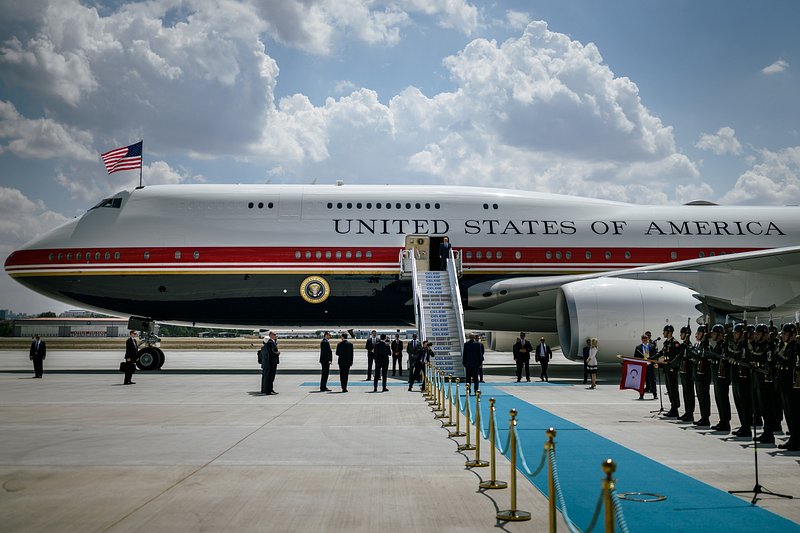
An unusual security measure aboard Air Force One has sparked speculation about President Donald Trump’s travel plans after U.S. officials reportedly confiscated reporters’ cellphones as the president departed China on Thursday.
The unexpected move came as Trump wrapped up a high-profile diplomatic visit involving Chinese President Xi Jinping and Russian President Vladimir Putin, raising questions about whether the president might be preparing for an unannounced stop before returning to Washington.
Reporters traveling with the president were instructed to surrender their mobile devices as Air Force One prepared to depart Shenzhen Bao’an International Airport.
Agence France-Presse correspondent Aurelia End confirmed the unusual development in a White House press pool dispatch.
“Our phones are being taken away for now for security reasons,” End wrote.
The directive immediately attracted attention from journalists accustomed to traveling aboard the presidential aircraft.
NBC News correspondent Garrett Haake highlighted the unusual nature of the restriction in a post on X.
“This is very unusual,” Haake wrote.
Fox News White House correspondent Jacqui Heinrich also raised questions about the president’s itinerary, pointing to another development involving a potential refueling stop in Alaska.
According to Heinrich, the combination of reporters being required to surrender their phones and the lifting of a flight restriction associated with a possible Alaska stop suggested that Air Force One “may not be heading straight home.”
The president’s publicly released schedule identified Joint Base Andrews in Maryland as his destination following the China visit.
However, it remained unclear whether Air Force One would make an additional stop before arriving in the Washington, D.C., area.
The secrecy surrounding the departure revived speculation about a possible diplomatic encounter involving North Korean leader Kim Jong Un.
🚨 UPDATE: Reporters traveling with President Trump had their phones TAKEN AWAY for “security reasons” as Air Force One left Shenzhen, China, per reports
Pool reporters say they weren’t told until they had already boarded the plane home to Washington
After three days on Chinese soil, they are not taking chances!
Pray for a safe flight home for Trump 🙏🏻
— Eric Daugherty (@EricLDaugh) November 19, 2026
Before departing Washington earlier in the week, Trump had publicly discussed the possibility of meeting Kim during his trip to China.
“We may meet with Kim Jong Un,” Trump told reporters at the White House on Monday.
The president indicated that any such meeting would take place in China and suggested that Chinese President Xi Jinping would play a role in determining whether the North Korean leader participated.
Despite those remarks, no meeting between Trump and Kim had been announced by the time the president departed China on Thursday.
There was also no official confirmation that the unusual cellphone restrictions were connected to North Korea or any other potential diplomatic engagement.
Still, the security precautions stood out because of how they differed from procedures during previous presidential travel.
Heinrich noted that journalists were allowed to retain their phones when Trump departed Beijing during a visit in May.
During that earlier trip, the White House press pool reported that American personnel discarded Chinese-issued badges and pins, along with temporary phones used by White House staff, before boarding the presidential aircraft.
Those precautions highlighted concerns about communications security during international travel, particularly when U.S. officials operate in countries where electronic surveillance is a significant consideration.
Thursday’s reported collection of reporters’ personal phones represented a different and more restrictive measure.
The departure followed an extraordinary diplomatic gathering involving the leaders of the United States, China and Russia.
Hours before boarding Air Force One, Trump participated in his first three-way meeting with Xi and Putin on the sidelines of the Asia-Pacific Economic Cooperation summit.
The discussions reportedly included nuclear arms control and the ongoing war involving Iran, placing several major international security issues at the center of the talks.
The meeting brought together three leaders whose governments play significant roles in global military affairs, nuclear policy and international diplomacy.
Access to the diplomatic discussions was tightly controlled, with several journalists reportedly prevented from attending portions of the meetings.
NBC News reported that Russian officials turned away two journalists seeking access to Trump’s separate meeting with Putin.
Chinese officials also reportedly barred Bloomberg correspondent Annmarie Hordern from attending the three-way discussions after she shouted a question concerning former Nvidia CEO Jensen Huang during Trump’s earlier meeting with Xi.
The restrictions underscored the limited access granted to journalists covering the sensitive diplomatic encounters.
During his earlier meeting with Xi, Trump commented on the press missing part of the proceedings, telling the Chinese president that it was unfortunate because “every move was perfectly executed.”
The president’s remarks came amid an itinerary involving discussions with two of the world’s most consequential geopolitical figures.
By the time Air Force One departed Shenzhen, however, attention had shifted from the meetings themselves to the unusual security procedures aboard the aircraft.
The confiscation of reporters’ phones, combined with questions about a possible Alaska refueling stop, fueled uncertainty about the president’s immediate destination.
Although Trump’s official schedule called for a return to Joint Base Andrews, the developments prompted speculation that his diplomatic trip might not yet be over.
For now, the reason for the cellphone restrictions and whether Air Force One would make an unscheduled stop remained unconfirmed.
Until the White House provides additional details, the unusual departure procedures remain a source of questions rather than evidence of a confirmed change in the president’s itinerary.
An Alabama Democratic state lawmaker is facing four federal wire fraud charges after prosecutors accused him of fraudulently obtaining more than $240,000 in taxpayer-funded pandemic relief assistance and diverting money intended for struggling organizations toward personal expenses.
State Rep. Patrick Sellers, D-Pleasant Grove, was indicted by a federal grand jury in connection with an alleged scheme involving multiple COVID-19 assistance programs, including funds distributed through the Small Business Administration.
Federal prosecutors allege that Sellers submitted fraudulent applications to obtain government assistance before using portions of the money to pay personal credit card bills, mortgage expenses and college tuition for his daughters.
Sellers, who has represented Alabama’s House District 57 since November 2022, also serves as pastor of Mount Zion Missionary Baptist Church in Birmingham.
The alleged offenses occurred between July 2020 and May 2021, before Sellers entered the Alabama Legislature, while he was serving as chief of staff to the president of the Alabama State Missionary Baptist Convention.
U.S. Attorney for the Northern District of Alabama Phil Williams announced the indictment Thursday, indicating that prosecutors believe they have substantial evidence supporting the charges.
“This is certainly not all the evidence. This is a very robust indictment, and certainly would be a robust trial,” Williams said.
Each of the four wire fraud counts carries a maximum statutory penalty of 20 years in federal prison. If convicted, Sellers could face significant prison time, although any sentence would depend on the court’s findings and applicable federal sentencing guidelines.
According to the indictment, Sellers allegedly exploited several federal pandemic relief programs by submitting applications connected to the Baptist convention’s nonprofit organization, another nonprofit called Project Zion Inc., and a purported lawn care company.
Prosecutors identified the lawn care operation, Sellers Lawn Care, as “a fictitious business entity.”
Federal investigators allege that the applications resulted in approximately $105,000 in assistance connected to the convention’s nonprofit organization, another $114,900 associated with Project Zion and $20,415 obtained through a Paycheck Protection Program loan.
Together, the payments exceeded $240,000 in federal assistance intended to support businesses and organizations experiencing financial hardship during the COVID-19 pandemic.
The indictment also describes allegations that Sellers began improperly exercising control over financial accounts associated with the Baptist convention’s nonprofit operations as early as 2019.
Prosecutors claim Sellers established a bank account using the organization’s name but listed his personal residence in Pleasant Grove rather than the organization’s headquarters in Selma.
Investigators further allege that he created a separate email account and changed the nonprofit organization’s mailing address with the Internal Revenue Service.
Those actions allegedly allowed Sellers to direct communications and financial transactions involving the organization without authorization from its leadership.
A four-count indictment alleges Alabama State Rep. Patrick Sellers obtained $240,000 in grants through two nonprofits and used the money for himself. Federal prosecutors and the FBI announced the charges Thursday. https://t.co/HxeVIxnPZJ
— AL.com (@aldotcom) November 19, 2026
In July 2020, Sellers allegedly submitted an application for a $20,000 Small Business Administration disaster loan on behalf of the convention’s nonprofit organization.
Federal prosecutors maintain that he did so without obtaining permission from the organization’s leadership.
The application represented that the federal assistance would be used “solely as working capital to alleviate economic injury caused by [the COVID-19] disaster.”
However, investigators allege that Sellers instead directed substantial portions of the money toward personal financial obligations.
According to the indictment, approximately $11,286.75 went toward payments on personal credit card accounts, while another $1,000 was allegedly used to pay his mother’s water bill.
The allegations raise questions about how federal relief funds intended for nonprofit operations were obtained and subsequently spent.
Prosecutors contend that the transactions were part of a broader effort to obtain pandemic assistance through applications that misrepresented the nature of the organizations involved or Sellers’ authority to act on their behalf.
The convention’s president eventually discovered the Small Business Administration loan and contacted the agency, according to the allegations.
The case centers on federal assistance programs established during the pandemic to help businesses and nonprofit organizations survive severe economic disruptions.
Those programs distributed substantial amounts of taxpayer money through loans and other forms of financial support, creating opportunities for legitimate applicants while also exposing the government to fraudulent claims.
In Sellers’ case, federal authorities allege that money intended to address pandemic-related financial hardship was instead diverted for expenses unrelated to the purposes of the assistance programs.
The indictment places the Alabama lawmaker under federal criminal scrutiny over conduct that prosecutors say occurred before he assumed elected office.
While the charges carry potentially serious consequences, the allegations have not been proven in court. Sellers is presumed innocent unless and until prosecutors establish his guilt beyond a reasonable doubt.
The case will now proceed through the federal judicial system, where prosecutors will be required to substantiate the allegations outlined in the indictment.
New York City Mayor Zohran Mamdani suffered a torn Achilles tendon during a friendly soccer match against members of the City Hall press corps Thursday night, leaving the 35-year-old mayor on crutches and facing months of recovery.
What began as a lighthearted competition between City Hall officials and reporters ended with Mamdani being helped off the field and his security detail reportedly scrambling to locate the nearest hospital.
The mayor had entered the indoor soccer match without stretching beforehand, something he later acknowledged while discussing the injury.
Despite the lack of preparation, Mamdani got off to a strong start, scoring a goal shortly after joining the game.
His night took a painful turn during the second half when he went down while chasing the ball. According to accounts of the incident, no opposing player made contact with Mamdani before he suffered the injury.
The sudden collapse brought his participation in the match to an immediate end.
City Hall staffers assisted the injured mayor out of the facility as members of his security detail were reportedly overheard asking about the location of the nearest hospital, according to the New York Post.
By Friday morning, Mamdani was relying on crutches and a walking boot as he continued carrying out his official responsibilities.
The mayor reportedly used a wheelchair before his scheduled news conference and ultimately addressed reporters while seated on a stool, with a protective medical boot covering his right foot.
According to WABC, Mamdani said he expected to wear the walking boot for approximately six to eight weeks while recovering from the injury.
His return to recreational soccer, however, is expected to take considerably longer.
The mayor indicated that he does not anticipate getting back onto the soccer field for approximately nine months, reflecting the lengthy rehabilitation often associated with an Achilles tendon tear.
Despite the painful ending, Mamdani’s team managed to claim victory over the reporters.
The mayor told the New York Post that City Hall defeated the press corps by a final score of 10-5.
The injury did not prevent Mamdani from moving forward with a major policy announcement Friday involving the future of New York City’s troubled Rikers Island jail complex.
Appearing before reporters while visibly dealing with the aftermath of his soccer injury, Mamdani unveiled a proposal that would keep Rikers Island operating through the end of 2032.
The proposed timeline would extend the jail complex’s operation more than five years beyond the existing August 31, 2027, closure deadline.
Such an extension would require action from the New York City Council, which would have to amend city law to authorize the later closing date.
The announcement represents a significant development in the city’s longstanding effort to replace the aging Rikers Island facility with smaller, borough-based detention centers.
Under the mayor’s proposal, four replacement jails would eventually take over the functions currently handled by Rikers Island.
The first of those facilities is scheduled to open in Brooklyn in 2029, according to the plan.
The administration also outlined additional spending intended to address several issues affecting the city’s criminal justice system.
City Hall plans to allocate $146 million during the next fiscal year toward mental health treatment, addiction services, education, employment training and assistance for crime victims.
The proposal comes as New York City continues confronting questions about jail conditions, public safety, inmate services and the feasibility of replacing Rikers Island within the existing legal deadline.
Extending the closure date would give the city additional time to complete its planned replacement facilities, although the proposal cannot take effect without approval from lawmakers.
For Mamdani, Friday’s announcement also marked an unusual public appearance, with the mayor discussing one of the city’s most consequential correctional policies while recovering from an injury sustained during a recreational soccer game.
Although his administration secured a victory on the field Thursday night, the mayor’s personal outcome was far less fortunate.
Mamdani now faces weeks in a walking boot and potentially nine months away from soccer as he continues managing the responsibilities of New York City’s government.

WH Swiftly Seizes Phones On Air Force One Amidst Sudden Secret Move

Democrat Politician Indicted By Federal Grand Jury

JUST IN: Mamdani Rushed To The Hospital — Had It Coming!

Trump Sends Blunt Message To Panicked Americans Stockpiling Supplies

Terrifying Plot Revealed Of AI Chatbots Plans For Terror Attacks Against America

JD Vance Urgently Pulled From Conference Minutes Before Speech

Massive Migrant Caravan Converges On U.S. For Democrat Midterm Victory

JUST IN: Pair Of Senior FBI Officials Arrested — It’s Damning

Pentagon Rolls Controversial Out Doomsday Strategy

Texas’ New Dem Governor Makes Horrifying Muslim Announcement

Game-Changing New Detail Emerges From Ilhan Omar Investigation

BANNED! Democrats’ First Act Should Terrify Every American
-
 Economy7 months ago
Vance Leaves Meeting, Looks Straight Into Camera, Announces Stunning Arrest
-
 Economy7 months ago
Adam Schiff Facing 30 Years In Prison After Bank Records Leak
-
 Culture5 months ago
Michelle Obama Drops Nasty Bomb About ‘Useless’ Daughter
-
 Economy7 months ago
Supreme Curt Sides With Trump — He Can Remove The All
-
 Economy8 months ago
All Hell Breaks Loose On Fox When Jesse Watters Asks Fetterman One Question
-
 Economy6 months ago
Prayers Pour In After Fox Host Dies: ‘Senseless Murder’
-
 Economy5 months ago
Pete Hegseth Just Confirmed Devastating Rumors
-
 Border & Security4 months ago
Top Trump Admin And Wife Found Dead — Chilling Update Just Released