
Latest
JUST IN: New Press Secretary Drops Bombshell About High-Profile Trump Official

# Trump Administration Shakeup: Kimberly Guilfoyle Asked to Resign as Ambassador Following Financial Allegations
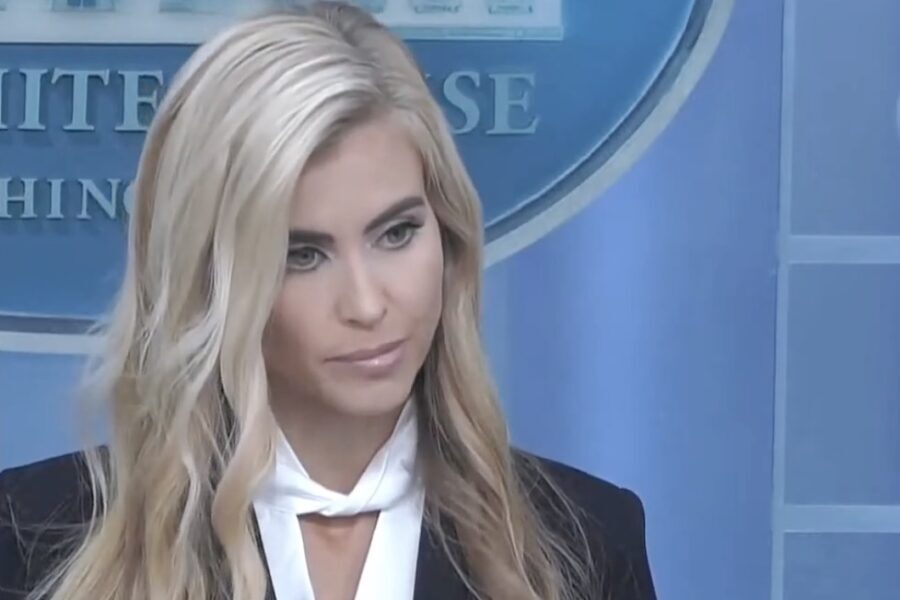
President Donald Trump’s administration announced a significant diplomatic shakeup Tuesday, with newly appointed White House Press Secretary Katie Zacharia revealing that Kimberly Guilfoyle had been asked to resign as U.S. ambassador to Greece following mounting scrutiny of her financial dealings.
The announcement came during Zacharia’s first official White House press briefing, marking an eventful debut for the administration’s newest public spokesperson.
“We have asked Ambassador Guilfoyle to resign. She has been a wonderful asset to the team and we wish her well,” Zacharia told reporters.
The decision follows a Wall Street Journal report alleging that Guilfoyle sought $100,000 from a Trump donor to help cover personal credit card debt before her Senate confirmation.
The allegations prompted questions about the ambassador’s financial arrangements and ultimately placed her diplomatic position under scrutiny.
Guilfoyle’s attorneys have denied wrongdoing, maintaining that the payments in question were connected to legitimate professional services performed before she assumed her ambassadorial duties.
No criminal charges or official findings of misconduct were identified in the report.
Trump had already signaled Monday that Guilfoyle’s future in the administration was uncertain, telling reporters that he was considering removing her from the diplomatic assignment.
By Tuesday, the White House had confirmed that the president’s team had requested her resignation.
The development represents a notable personnel change involving a longtime Trump ally who has maintained close ties to the president’s political circle.
Guilfoyle, a former television personality and prominent Republican fundraiser, has been a familiar figure in Trump-aligned political activities for years.
Her appointment as ambassador to Greece placed her in a significant diplomatic position responsible for representing American interests in a strategically important NATO ally.
The reported resignation request now raises questions about who will succeed her and how the administration will manage the transition at the U.S. Embassy in Athens.
The announcement also immediately placed Zacharia in the national spotlight as she assumed one of the White House’s most visible communications roles.
Zacharia officially began serving as press secretary Monday before conducting her first briefing Tuesday.
She succeeds Karoline Leavitt, who departed the White House in August.
Trump announced Zacharia’s selection Friday, bringing another communications professional with experience in conservative media and Trump-affiliated organizations into his administration.
Before joining the White House, Zacharia worked as a communications adviser for Trump Media & Technology Group, the parent company of Truth Social.
She also briefly served as a spokesperson for the Department of Homeland Security and appeared as a political commentator on Fox News and Newsmax.
Opening her first briefing, Zacharia expressed appreciation for the opportunity to serve the president.
She told reporters she had wanted to work for Trump “for a long time” and described the appointment as an important milestone in her career.
“I’m thrilled to officially be a part of this incredible journey together,” Zacharia said.
Her remarks emphasized enthusiasm for the administration’s priorities and her new responsibility as one of its principal public representatives.
Zacharia also highlighted Trump’s Monday night campaign rally in Youngstown, Ohio, where the president promoted his economic agenda ahead of the November midterm elections.
The new press secretary pointed to the administration’s economic record as Republicans prepare for the final weeks of campaigning.
Her comments reflected the White House’s effort to keep its policy and economic messaging at the forefront even as personnel changes attract national attention.
The Guilfoyle announcement, however, ensured that questions about the administration’s diplomatic appointments would be a major focus of Zacharia’s debut.
The White House’s decision to request Guilfoyle’s resignation comes before any publicly identified finding that she violated the law or committed official misconduct.
Her attorneys continue to dispute the characterization of the financial transactions, arguing that the payments involved legitimate services rather than improper conduct.
The distinction remains important as the allegations receive additional public scrutiny.
For Trump, the reported decision marks another high-profile personnel adjustment as his administration approaches a consequential midterm election.
For Zacharia, the first briefing offered an immediate introduction to the challenges of representing the White House during an unfolding controversy.
And for Guilfoyle, the resignation request places her diplomatic career in uncertainty as questions surrounding the reported financial arrangements remain unresolved.
The administration has not identified a replacement ambassador or provided a detailed timetable for the transition.
The announcement nevertheless signals that the White House is moving forward with a change in its diplomatic representation in Greece while continuing to emphasize Trump’s broader economic and political priorities.
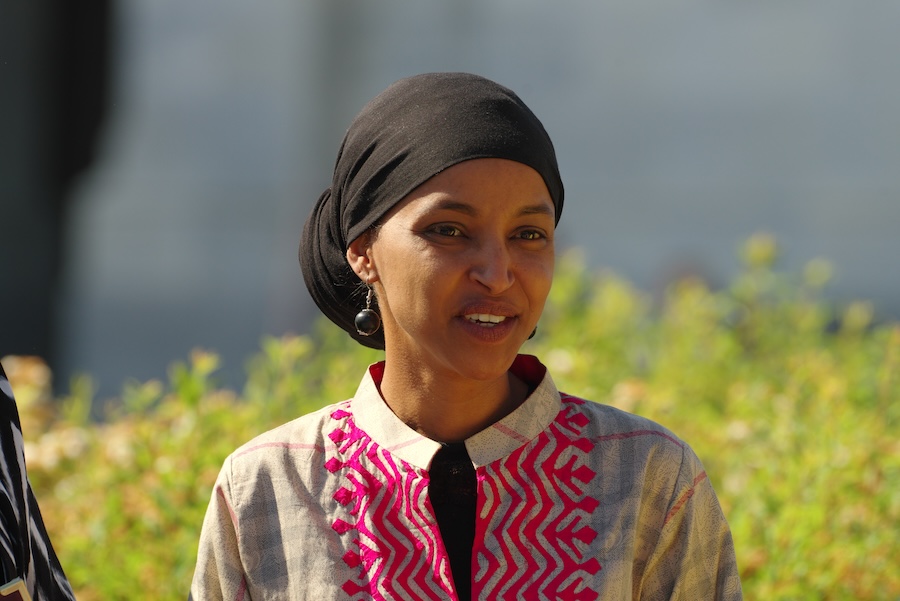
A reported federal investigation involving Rep. Ilhan Omar (D-Minn.) has expanded to members of her family, with investigators issuing subpoenas as they examine possible fraud and false statements in immigration records, according to The New York Times.
The latest development follows a reported search of Omar’s Washington, D.C., residence Monday, during which Department of Homeland Security agents reportedly removed boxes of documents.
According to the Times, federal investigators have subpoenaed Omar’s sister, Sahra Noor, along with at least one other person connected to the congresswoman’s family.
Noor, a health care professional and author, was among those who received subpoenas, according to people familiar with the investigation who spoke anonymously because they were discussing confidential investigative activity.
The subpoenas suggest investigators are seeking additional testimony or records concerning the family’s immigration history, although the full scope of the inquiry remains unclear.
A central focus reportedly involves Omar’s late father, Nur Omar Mohamed, and whether he provided inaccurate information or omitted relevant details on immigration documents before becoming a naturalized American citizen.
Mohamed died in 2020.
The investigation reportedly includes questions about whether statements made during the family’s immigration process complied with federal requirements.
However, the reporting does not establish that Omar, her father or any other family member knowingly submitted fraudulent information.
Grand jury subpoenas are investigative tools used to obtain documents or testimony. Receiving one does not necessarily mean that the recipient is suspected of committing a crime.
The latest disclosures nevertheless bring additional attention to an investigation involving one of the most prominent progressive Democrats in Congress.
President Donald Trump weighed in Tuesday, publicly raising allegations of immigration fraud and questioning Omar’s finances.
In a social media statement, Trump suggested that the Minnesota congresswoman had engaged in immigration-related misconduct and financial fraud.
“America wants answers, and we want them, NOW!” the president declared.
Trump’s accusations have not been established by the reported subpoenas or search, and federal prosecutors have not publicly announced criminal charges against Omar in connection with the allegations.
Omar has repeatedly denied wrongdoing involving her immigration history.
Following the reported search of her residence, she accused the Trump administration of using federal law enforcement to pursue political opponents.
She described the investigation as an effort “to target political enemies and weaponize federal law enforcement.”
Her response reflects the growing political controversy surrounding the investigation, which is unfolding just weeks before the November elections.
The timing has become a major point of dispute.
Federal law enforcement agencies traditionally exercise caution when taking public investigative steps involving political candidates close to an election, particularly when those actions could influence public perceptions of a race.
Those considerations do not impose an absolute prohibition on investigative activity, however. Authorities may proceed when circumstances warrant action, including concerns about preserving evidence or preventing further criminal conduct.
The decision to search Omar’s residence so close to Election Day has prompted criticism from attorneys and government accountability advocates who question whether political considerations influenced the investigation.
Norman Eisen, an attorney who has repeatedly challenged Trump administration actions in court, said a nonprofit organization with which he works had requested an investigation by the Office of Special Counsel.
The request reportedly asks whether administration officials violated the Hatch Act by improperly using federal authority for political purposes.
The Hatch Act restricts certain political activities by federal employees, including the misuse of official authority to influence elections.
“Officials can’t use criminal power to affect an election,” Eisen wrote on social media.
“This is the textbook case.”
Eisen’s comments represent an allegation about the administration’s conduct, not a legal finding that a Hatch Act violation occurred.
Randall Eliason, a former federal prosecutor and retired law professor, also questioned the circumstances surrounding the search.
Eliason suggested that previous controversies involving the Justice Department had undermined public confidence in the impartiality of its actions.
He argued that the department had “sort of forfeited the right to a presumption of regularity,” referring to the legal principle that government officials are generally presumed to perform their duties lawfully and in good faith.
“With all of the other things they have done to politicize the department and use its power to go after the president’s enemies,” Eliason said, “it certainly looks extremely suspicious.”
But he also acknowledged an important limitation.
Without reviewing the affidavit submitted to obtain the search warrant, Eliason said it was impossible to determine conclusively whether the operation was improper.
That distinction is central to evaluating the investigation.
A federal search warrant generally requires investigators to present sufficient evidence for a judge to find probable cause that evidence of a crime will be located in the place being searched.
Judicial approval does not establish that a crime occurred, but it does mean the warrant application met the legal threshold for authorizing the search.
The underlying affidavit could provide important information about the suspected offenses, the evidence investigators have gathered and why authorities sought documents from Omar’s residence.
That information has not been publicly disclosed in the reporting provided.
Meanwhile, the subpoenas involving Omar’s family could help investigators reconstruct the circumstances surrounding immigration documents prepared years before the congresswoman entered public office.
Such an inquiry may involve examining who completed particular forms, what information was available at the time and whether any inaccuracies were intentional or legally significant.
Those questions matter because an error or omission in historical immigration paperwork does not automatically establish fraud by every family member connected to the application.
Investigators would need evidence linking a specific individual to a legally actionable false statement or other offense.
The Times reported that Noor did not respond to its requests for comment, including emails and a telephone call answered by someone who identified herself as Noor’s daughter.
The newspaper’s sources did not publicly identify the other subpoena recipient or disclose the specific documents or testimony investigators were seeking.
For now, the reported search and subpoenas indicate that federal authorities are pursuing information concerning Omar’s family immigration history.
They do not establish that the congresswoman committed immigration fraud, obtained citizenship unlawfully or engaged in financial misconduct.
The political dispute surrounding the investigation is likely to continue as Election Day approaches, with Trump demanding answers and Omar accusing his administration of targeting a political opponent.
The central questions remain what evidence investigators have presented, whether any alleged inaccuracies amount to criminal violations and whether the investigation has been conducted independently of political considerations.
Until those details become public, the investigation remains unresolved, and the reported allegations must be distinguished from proven wrongdoing.
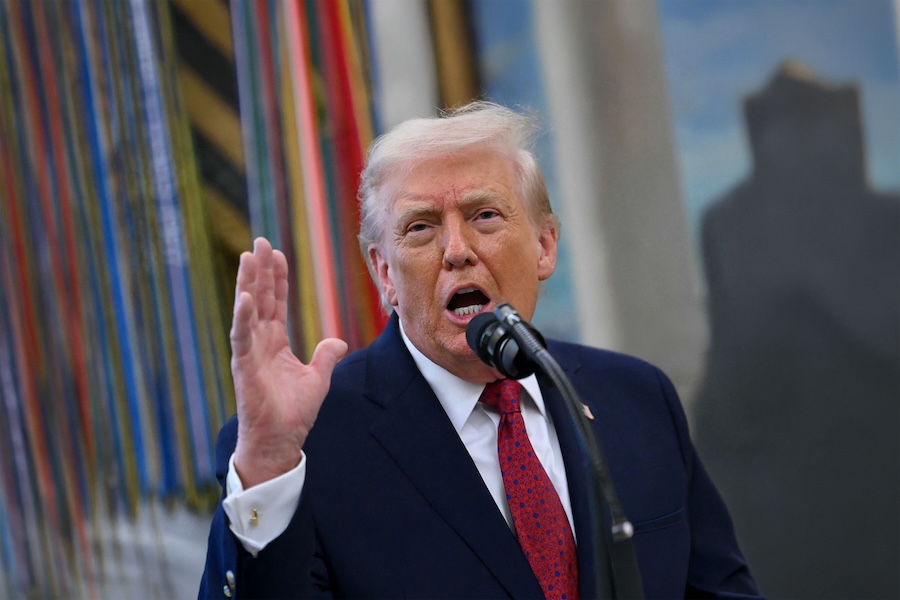
# Kimberly Guilfoyle Breaks Silence After Trump Administration Demands Resignation, Vows to Fight Explosive Allegations
Kimberly Guilfoyle is preparing to leave her position as U.S. ambassador to Greece, but the longtime Trump ally is making one thing clear: her loyalty to President Donald Trump and the America First movement remains unchanged.
Guilfoyle publicly addressed her departure Tuesday after the White House confirmed that the administration had requested her resignation amid mounting scrutiny over allegations involving her personal financial dealings.
In a statement posted on X, Guilfoyle defended her diplomatic record, rejected accusations of misconduct and pledged to fight allegations she insists are false.
“While my time as Ambassador may be coming to an end, my commitment to President Trump, the America First movement, and the country I love will never end,” Guilfoyle declared.
Her statement followed an announcement from newly appointed White House Press Secretary Katie Zacharia, who confirmed the personnel decision during her first official briefing Tuesday.
“We have asked Ambassador Guilfoyle to resign. She has been a wonderful asset to the team and we wish her well,” Zacharia told reporters.
Trump had signaled Monday that Guilfoyle’s diplomatic position was under review following a series of Wall Street Journal reports examining her financial arrangements.
One report alleged that Guilfoyle approached Trump donor Eric Deters about covering a $100,000 personal credit card bill before her Senate confirmation hearing.
According to the report, Guilfoyle allegedly offered to use her connections within the Trump administration to assist Deters with legal and tax matters.
Deters reportedly declined to pay the bill.
The allegations have raised questions about whether Guilfoyle’s financial dealings were appropriate for someone preparing to assume a high-profile diplomatic assignment.
Guilfoyle and her legal representatives, however, have strongly disputed suggestions of wrongdoing.
Her attorneys previously maintained that the money she sought involved unpaid compensation for legitimate public appearances and speaking engagements that occurred before her ambassadorial nomination.
They also rejected allegations of impropriety surrounding private aircraft travel, arguing that Guilfoyle complied with applicable State Department guidance.
In her Tuesday statement, Guilfoyle directly confronted the accusations and made clear that she intends to defend her reputation.
“I also want to address the recent allegations against me. These allegations are false, and I intend to vigorously defend my name, my reputation, and my integrity,” she wrote.
“I have dedicated my professional life to fighting for justice, standing up for what is right, and defending the values that make America exceptional. I will not allow false accusations to define my decades of public service.”
The allegations remain disputed, and the reporting does not establish that Guilfoyle has been criminally charged or found responsible for misconduct.
Despite the circumstances surrounding her departure, Guilfoyle avoided publicly criticizing Trump or Secretary of State Marco Rubio.
Instead, she opened her statement by expressing gratitude for the opportunity to serve the United States overseas.
“Serving as the United States Ambassador to Greece has been the honor of a lifetime. I will forever be grateful to President Donald J. Trump and Secretary of State Marco Rubio for entrusting me with the extraordinary privilege of representing the greatest country in the history of the world.”
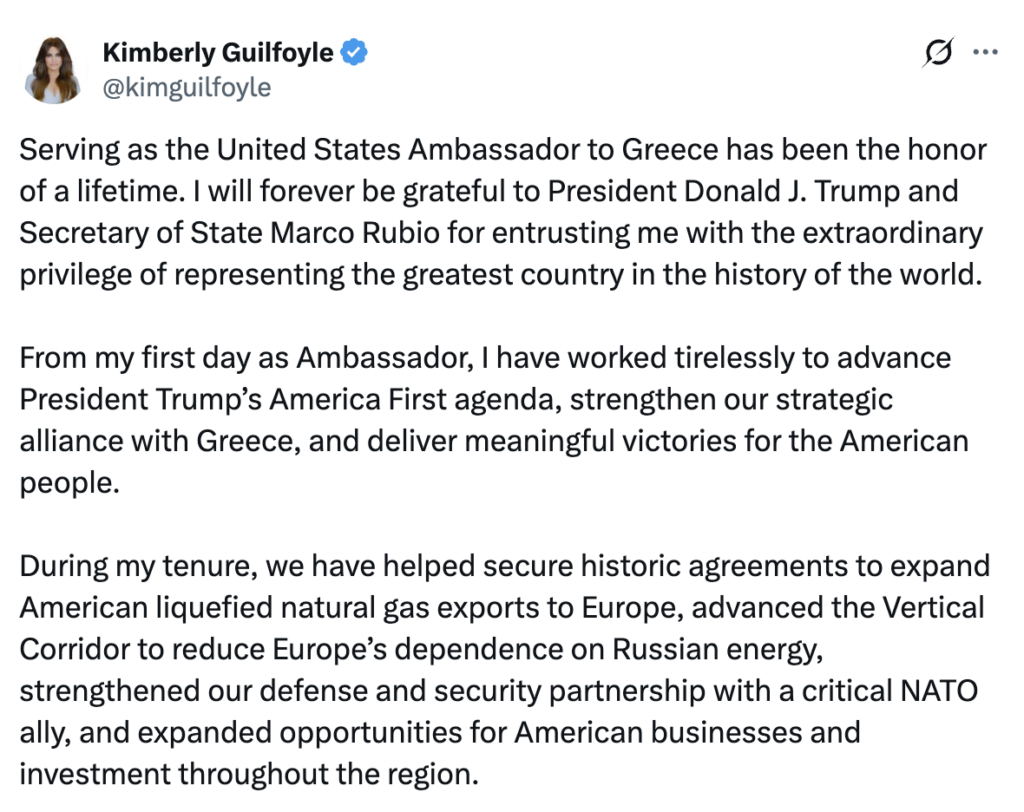
Guilfoyle also defended her accomplishments during her diplomatic assignment, emphasizing initiatives intended to strengthen American economic and strategic interests in southeastern Europe.
Among the priorities she highlighted were expanding U.S. liquefied natural gas exports to European markets, strengthening defense cooperation with Greece and creating additional opportunities for American businesses.
She also pointed to work involving the Vertical Corridor, an energy infrastructure initiative intended to improve the movement of natural gas across southeastern and central Europe while reducing regional dependence on Russian energy supplies.
Guilfoyle credited Trump, Rubio and American diplomatic personnel for advancing those efforts.
Her defense of the assignment appeared intended to separate her record as ambassador from the personal financial allegations now surrounding her departure.
The resignation request represents a notable development for Guilfoyle, who has spent years as a prominent figure in Trump’s political circle.
A former television personality, prosecutor and Republican fundraiser, she became widely recognized for her appearances at conservative political events and her outspoken support for Trump’s presidential campaigns.
Her appointment to the diplomatic post in Greece marked a transition from political advocacy to representing the United States in an official international capacity.
The White House’s decision to request her resignation now brings that chapter toward a close.
However, Guilfoyle’s statement suggests she intends to remain publicly involved in the political movement she has supported for years.
Rather than distancing herself from the president following the administration’s decision, she reaffirmed her commitment to his agenda.
“My gratitude and respect for President Trump and Secretary Rubio remain unwavering,” Guilfoyle stated.
“I am proud of what we accomplished together, and I will always be a loyal supporter of President Trump and his mission to Make America Great Again.”
The statement leaves several questions unresolved, including whether Guilfoyle will formally submit her resignation immediately, who will replace her in Athens and whether the financial allegations will lead to additional official scrutiny.
For now, the White House has confirmed its request for her departure, while Guilfoyle has denied wrongdoing and pledged to defend herself.
Her response also underscores an unusual political dynamic: even as the Trump administration moves to end her diplomatic assignment, Guilfoyle is publicly reaffirming her loyalty to the president.
The allegations may have brought her time as ambassador to an end, but according to Guilfoyle, they will not end her involvement in the America First movement.
And while she prepares to leave the diplomatic post, she is making clear that she has no intention of allowing the accusations to go unanswered.
New early voting figures from Michigan are drawing attention to one of the nation’s closely watched Senate contests, with a Democratic advantage narrowing to just 4,605 ballot returns as Republicans make gains in the latest reported numbers.
An October 12 update from Election Data Guy shows Republicans adding more early and mail ballot returns than Democrats over the previous day, reducing the Democratic-labeled lead by 651.
The figures suggest a closely divided early electorate, although they do not establish which candidates voters actually supported.
According to the analyst’s model, 393,683 early and mail ballots had been returned, with 195,132 classified as Democratic, 190,527 as Republican and 8,023 falling into an “other” category.
That leaves Democrats with a reported advantage of just 4,605 returns.
The analyst refers to that margin as the Democratic “firewall,” a term describing the difference between the two modeled partisan categories rather than an official election result.
The latest movement shows Republicans narrowing that gap.
According to the October 12 graphics, Democratic-labeled returns increased by 22,708 over the previous day, while Republican-labeled returns climbed by 23,449.
The “other” category added another 935 returns.
Those figures indicate that Republican-classified ballots outpaced Democratic-classified ballots in the latest daily update.
The overall Democratic advantage remains intact within the model, but the difference has become smaller.
The development is attracting attention because Michigan has been a closely contested state in recent national elections, making early participation patterns a subject of considerable interest to both political parties.
However, early ballot returns are not the same as votes counted for a particular candidate.
Michigan voters cast secret ballots, and the analyst’s partisan classifications do not establish how individual voters marked their Senate choices.
The published graphics also do not explain how Election Data Guy assigns party labels to returned ballots or independently validates those classifications.
That limitation is particularly important in Michigan, where voters do not register by political party.
As a result, the figures should be understood as a third-party estimate of partisan participation rather than an official tally of Democratic and Republican votes.
The analyst’s broader forecast reinforces the uncertainty surrounding the contest.
Despite the narrowing Democratic advantage, Election Data Guy continues to classify the Senate race as a “Tossup.”
The model assigns both Democrats and Republicans a projected vote-share range of 46 percent to 52 percent.
Because those ranges overlap completely, the forecast does not identify a clear favorite.
The analyst also projects final turnout of approximately 52 percent, although the graphics do not provide enough methodological detail to independently assess that estimate.
For campaign observers, the latest figures offer a snapshot of reported early participation rather than a reliable prediction of the eventual outcome.
The model’s comparison with 2024 adds another dimension to the numbers.
Democratic-labeled ballots currently account for 49.57 percent of reported returns, compared with 49.08 percent in the analyst’s corresponding 2024 figures.
Republican-labeled ballots represent 48.40 percent of the current total, compared with 48.94 percent in the earlier benchmark.
The “other” category stands at approximately 2.04 percent, slightly above the 1.98 percent shown for 2024.
Those comparisons complicate any interpretation that the latest daily movement demonstrates a decisive shift toward either party.
Republicans added more classified returns in the most recent update, while Democrats retain a slightly higher share than the analyst’s displayed 2024 comparison.
Both observations can be accurate because they measure different aspects of early participation.
The graphics do not establish whether the 2024 comparison uses equivalent dates, stages of early voting or identical classification methods.
Without that information, the historical percentages cannot definitively establish whether either party is outperforming its previous election participation.
The relatively small modeled margin also illustrates why early voting statistics can change quickly.
A difference of 4,605 returns represents only about 1.2 percent of the nearly 394,000 ballots included in the analyst’s dataset.
Additional returns could substantially alter that margin before Election Day, particularly as voting activity increases during the final weeks of the campaign.
The figures also leave unanswered how many remaining voters will participate in person on November 3 and whether their preferences will differ from those of early voters.
Those unknowns are central to interpreting any pre-election participation model.
For Democrats, the October 12 snapshot shows a modest advantage in the analyst’s early-return categories.
For Republicans, the latest daily figures show a reduction in that advantage.
Neither development establishes the outcome of the Senate election.
The distinction matters because the term “firewall” can imply a dependable electoral advantage even though the underlying figures represent modeled party classifications rather than verified candidate support.
The latest update therefore offers evidence of a closely divided early-return dataset, not proof of a statewide electoral shift.
With weeks remaining before voters finish casting their ballots, Michigan’s Senate contest continues to draw attention from both parties.
The reported 4,605-return gap and the analyst’s overlapping projected vote ranges underscore how much remains uncertain.
Ultimately, the official election results—not early ballot classifications, turnout projections or partisan models—will determine the outcome of Michigan’s Senate race.

Ilhan Omar’s Family Just Hit With Horrible News

JUST IN: It’s Official — She’s OUT! Good Riddance!

Early Voting Numbers In — Abdul El Sayed Learns His Fate

JUST IN: Longtime Fox News Host Breaks Silence On Career Plans

She’s DONE! Explosive Undercover Video Exposes Ilhan Omar

Trump Just Released Obama Emails — Could Mean JAIL

Obama Calls It QUITS After Wild Video Goes Viral

Joe Biden’s Daughter Just Dropped Massive Public Bombshell On Her Dad

Removed From the Country — Ilhan Omar Hit With Horrid News

Get Ready — Mike Pence Makes Stunning 2028 Announcement

Jeanine Pirro Makes Massive Announcement – WH In Total Shock

JUST IN: ‘Squad’ Congressional Candidate Arrested
-
 Economy6 months ago
Vance Leaves Meeting, Looks Straight Into Camera, Announces Stunning Arrest
-
 Economy6 months ago
Adam Schiff Facing 30 Years In Prison After Bank Records Leak
-
 Economy6 months ago
Supreme Curt Sides With Trump — He Can Remove The All
-
 Culture4 months ago
Michelle Obama Drops Nasty Bomb About ‘Useless’ Daughter
-
 Economy6 months ago
All Hell Breaks Loose On Fox When Jesse Watters Asks Fetterman One Question
-
 Economy4 months ago
Prayers Pour In After Fox Host Dies: ‘Senseless Murder’
-

 Latest4 months ago
Fox News Stuns With Announcement About 5 Fired Hosts
-

 Border & Security2 months ago
Top Trump Admin And Wife Found Dead — Chilling Update Just Released