
Latest
Ilhan Omar’s Sister FLIPS — Blows Entire Case Wide Open!

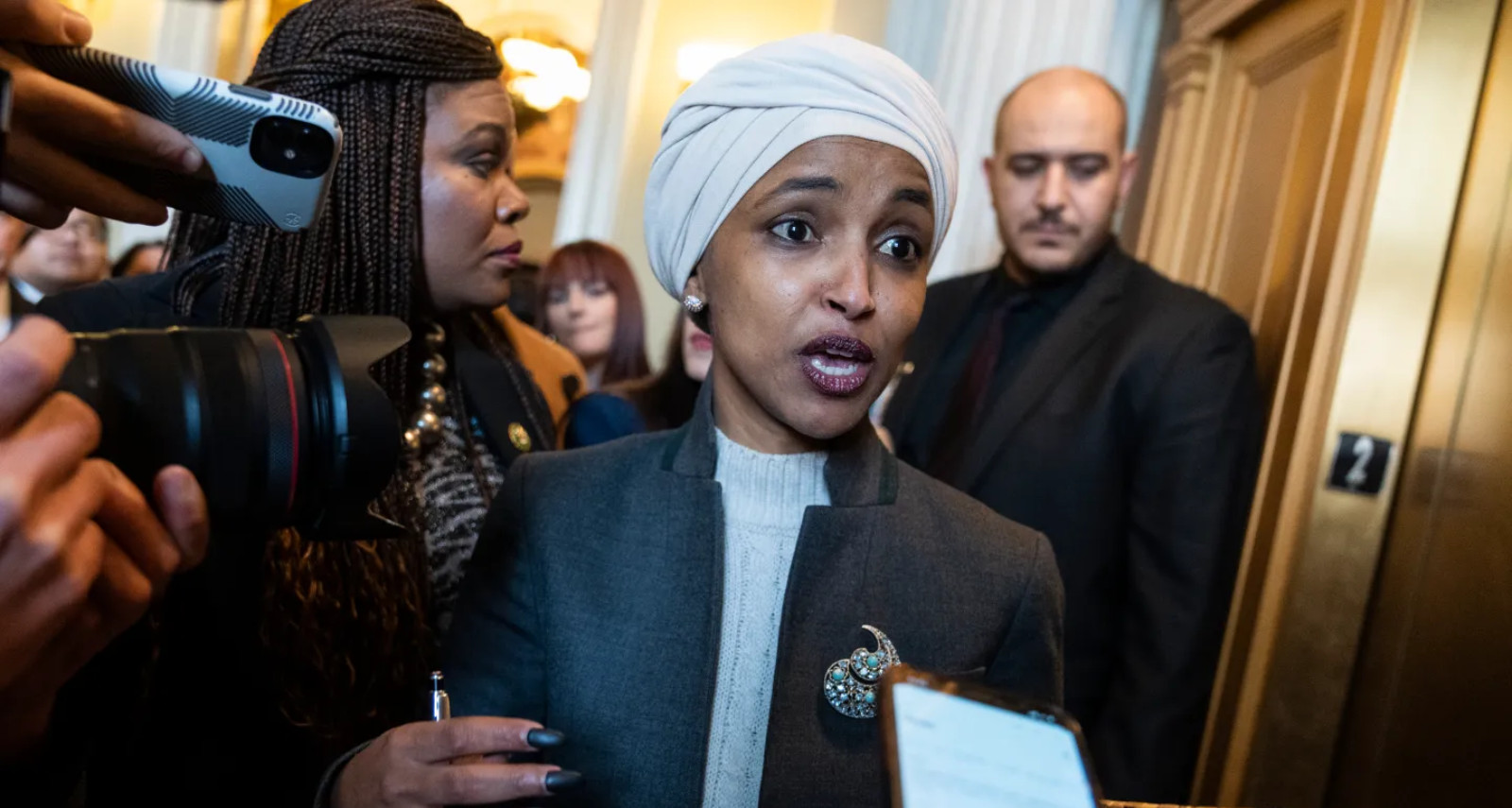
A new development in the federal investigation involving Rep. Ilhan Omar is drawing attention to the Minnesota Democrat’s family after Reuters reported that one of her sisters voluntarily spoke with federal investigators.
The reported interview represents another avenue of inquiry for authorities examining allegations concerning Omar’s immigration and citizenship records, which date back to her family’s arrival in the United States decades ago.
According to Reuters, which cited a person familiar with the investigation, Omar’s sister agreed to speak with federal agents rather than participating solely in response to a compulsory legal demand.
The news organization did not identify which sister participated in the conversation or disclose what information she provided.
It also did not report that the relative accused Omar of wrongdoing, supplied incriminating evidence or entered into a formal cooperation agreement with federal prosecutors.
Those distinctions are significant because voluntarily speaking with investigators does not necessarily indicate that a witness possesses evidence of criminal activity.
Nevertheless, the development comes as federal authorities reportedly expand their examination of Omar’s family immigration history through interviews, subpoenas and documents collected during a search of her Washington, D.C., residence.
The Associated Press previously reported that investigators issued more than a dozen grand jury subpoenas while examining potential fraud involving immigration paperwork associated with Omar and her relatives.
Some of those subpoenas were reportedly directed to members of the congresswoman’s family.
According to the AP, the subpoenas were issued in connection with a grand jury gathering evidence in Minnesota.
The report also indicated that federal agents seized Omar’s cellphone during a search of her Washington residence on Monday, October 12.
Together, those reported investigative steps suggest that authorities are seeking information from multiple sources rather than relying exclusively on documents obtained during the search.
Grand jury subpoenas can require individuals to provide records or testimony relevant to an investigation.
Voluntary interviews, by contrast, generally involve individuals agreeing to answer investigators’ questions without being compelled to participate through that particular process.
The distinction does not establish whether a witness supports or disputes the allegations being investigated.
In this case, the contents of the reported interview remain unknown.
Earlier coverage identified one of Omar’s sisters, Sahra Noor, as a recipient of a subpoena.
The National News Desk, citing reporting from The New York Times, reported that Noor and at least one other relative had received subpoenas connected to the inquiry.
However, Reuters did not identify the sister who voluntarily spoke with federal agents.
There is no publicly established basis in the supplied reporting to conclude that Noor was the individual involved in that separate interview.
The broader investigation reportedly centers on information submitted during Omar’s family’s immigration and naturalization proceedings.
Omar was born in Somalia and arrived in the United States as a refugee in 1995 before becoming an American citizen in 2000.
Federal investigators are reportedly examining whether records associated with her family’s entry into the country and subsequent citizenship proceedings contained inaccurate information.
The Washington Post reported that investigators were reviewing questions involving Omar’s date of birth and her late father’s background.
Those matters could be relevant to determining how her citizenship was obtained and whether information provided during the process was accurate.
However, the existence of questions about historical records does not establish that Omar or her relatives knowingly submitted false information.
The specific evidence underlying the allegations has not been publicly disclosed in the supplied reporting.
Investigators have also reportedly examined financial disclosures associated with the congresswoman.
The Washington Post described that inquiry as a separate investigative matter, highlighting that federal authorities are reviewing more than one set of allegations.
The existence of parallel inquiries does not establish that the matters are legally connected or that wrongdoing occurred in either case.
Omar has repeatedly denied committing immigration fraud and has characterized the investigation as politically motivated.
The controversy intensified after Homeland Security Investigations agents searched her Washington-area residence on October 12.
According to the Associated Press, the Justice Department confirmed that agents executed a judicially authorized search warrant as part of an ongoing criminal investigation.
Federal officials initially released limited information about the search, including the evidence supporting the warrant and the materials investigators were authorized to seize.
The operation drew immediate political attention because it involved a sitting member of Congress seeking reelection just weeks before the November 3 midterms.
Omar responded by accusing the Trump administration of using federal law enforcement to intimidate political opponents.
She argued that the investigation was part of a longstanding campaign against her and rejected allegations concerning her immigration history.
Democratic congressional leaders also questioned the timing of the search, pointing to Justice Department practices intended to minimize the risk that investigative actions could improperly affect elections.
Federal law enforcement officials, meanwhile, have defended the investigation and emphasized that the search was authorized by a judge.
A judicially approved warrant generally requires investigators to establish probable cause that evidence connected to a crime may be found at a particular location.
That authorization permits a search within the warrant’s legal limits.
It does not establish that the person whose property is searched has committed a criminal offense.
The Wall Street Journal previously reported that the search was connected to a longer-running investigation involving Omar’s immigration history.
The newspaper also acknowledged that Omar has denied allegations concerning her family’s records.
The reported voluntary interview with her sister introduces another potentially relevant source of information, although investigators have not publicly explained what they learned.
Family members may possess knowledge about historical events, dates, identities or documents that could help authorities evaluate discrepancies in immigration records.
Such testimony could corroborate existing information, contradict allegations or provide context for records that investigators are attempting to interpret.
Without knowing what was discussed, however, it would be premature to characterize the interview as evidence against Omar.
The investigation remains subject to several unresolved questions.
Authorities have not publicly identified the sister interviewed by Reuters’ source, disclosed her statements or established that she is cooperating with prosecutors in building a case against the congresswoman.
The available reporting also does not establish whether additional voluntary interviews have occurred.
Nor does it demonstrate that the grand jury has returned an indictment against Omar.
The investigation’s political implications remain substantial because of Omar’s prominence in Congress and her longstanding disagreements with President Donald Trump.
Omar and her supporters argue that the scrutiny reflects political retaliation.
Federal authorities have pursued the inquiry through investigative procedures that include subpoenas and a judicially authorized search.
Those competing positions do not resolve the underlying factual questions about the immigration records.
Ultimately, any criminal case would require prosecutors to establish the elements of a specific offense through admissible evidence and the applicable legal standards.
The reported interview with Omar’s sister may help investigators evaluate historical information, but its significance cannot be determined without knowing what the witness actually said.
For now, the latest development shows that the federal inquiry is reaching beyond the congresswoman herself and into sources familiar with her family’s immigration history.
Whether those efforts produce evidence supporting criminal charges, clarify disputed records or lead investigators away from the allegations remains unknown.
Omar continues to deny wrongdoing, and no criminal charges against her have been established in the supplied reporting.
As the investigation proceeds, attention will remain focused on what federal authorities can substantiate, what witnesses have told investigators and whether prosecutors ultimately present a case supported by evidence rather than allegations alone.

Democrats anticipating major gains in the November midterm elections may have reason to temper their expectations, according to CNN senior data reporter Harry Enten, who warned that even a modest polling error could dramatically change the outcome of closely contested congressional races.
During a Friday segment, Enten examined polling averages in several battleground states and explained why narrow Democratic leads should not be mistaken for guaranteed victories.
His central concern was the historical difference between final polling averages and actual election results, particularly in competitive Senate races.
With Republicans holding a 53-47 Senate majority, Democrats are attempting to capture enough seats to regain control of the chamber.
Current polling averages cited by Enten show Democratic candidates leading in several races that could prove important to that effort.
According to his analysis, Democrats held a four-point advantage in Ohio, three-point leads in Michigan and Texas, a two-point lead in Maine and a one-point edge in Iowa. Kansas was effectively tied.
If those polling averages translated directly into election results, the projected Democratic gains could be sufficient to change control of the Senate.
But Enten cautioned that history provides little justification for treating such narrow advantages as secure.
His analysis found that final polling averages in competitive Senate elections have differed from actual results by approximately 3.7 percentage points on average.
That figure is particularly significant because most of the Democratic leads in the races he examined fall within that historical range.
A relatively small shift between polling expectations and Election Day results could therefore change which party wins several pivotal contests.
Enten described the possibility as a “big siren warning sign for Democrats.”
The warning reflects a recurring challenge for political polling: Surveys provide estimates of voter preferences, but they cannot perfectly anticipate turnout, late shifts in opinion or differences between the people who respond to polls and those who ultimately cast ballots.
Even well-conducted surveys can produce results that differ from the final vote.
Enten illustrated the potential consequences by examining a hypothetical scenario in which Republican candidates outperform current polling averages by 3.75 percentage points.
Under that assumption, his analysis produced a 52-48 Republican Senate majority, with the GOP winning closely contested races in Maine, Michigan, Texas, Kansas, Iowa and Alaska.
The scenario was not a forecast that Republicans would necessarily achieve those results.
Instead, it demonstrated how a polling error comparable to historical averages could change the apparent balance of several races.
Enten also examined what a similar Republican overperformance could mean for the House of Representatives.
With control of the chamber closely divided, relatively small shifts in competitive districts could have substantial consequences.
The supplied analysis described Republicans as holding a 218-214 advantage, with two vacancies and one independent caucusing with the party.
Under Enten’s hypothetical Republican polling shift, the GOP would retain control of the House as well.
The exercise underscores how closely divided congressional majorities can make election outcomes sensitive to modest changes in voter support.
Enten has raised similar concerns in previous discussions of polling accuracy.
During a September analysis, he examined historical polling discrepancies in Iowa, Ohio and Michigan, states where Democratic candidates have recently registered encouraging survey numbers.
According to the figures cited in his analysis, Republicans outperformed September polling averages by approximately nine percentage points in Iowa, six points in Ohio and five points in Michigan during major 2024 contests.
Those discrepancies were substantial enough to change expectations about several races.
Enten also pointed to the 2018 midterm elections, when Republicans reportedly exceeded September polling averages by six points in Iowa and Ohio and eight points in Michigan.
The examples are noteworthy because they suggest that Republican polling overperformance in those states has not been limited to presidential elections featuring Donald Trump.
However, historical polling errors are not necessarily predictive of future results.
Polling organizations regularly adjust their methodologies, and differences in candidates, voter turnout, political conditions and survey participation can produce different outcomes from one election cycle to another.
A polling miss favoring Republicans in a previous election does not establish that a similar error will occur in November 2026.
Enten acknowledged that distinction, emphasizing that polling averages remain useful indicators even when they cannot guarantee a result.
A candidate leading in credible polling generally occupies a more favorable measured position than one trailing, but a narrow advantage still leaves meaningful uncertainty.
The distinction is especially important in Senate races where the reported margins are only one, two or three percentage points.
Those differences can be smaller than ordinary sampling uncertainty, and the historical polling errors Enten discussed reflect additional sources of uncertainty beyond the stated margin of error of an individual survey.
The House presents a somewhat different electoral picture.
Democrats have generally shown stronger numbers in national generic-ballot polling, which asks voters which party they would support for Congress rather than measuring individual candidates.
But national polling advantages do not translate directly into a specific number of House seats.
District boundaries, local candidates, incumbency and the geographic distribution of voter support all influence how national preferences translate into congressional representation.
Consequently, a relatively small shift in the national political environment could affect multiple competitive House districts without necessarily producing a uniform change across the country.
The uncertainty has contributed to intense campaign spending as both parties compete for control of Congress.
Reuters reported Monday that more than $3.8 billion in political advertising had already aired during the 2026 midterm election cycle.
Senate contests in Texas, Ohio and Michigan have attracted particular attention as campaigns and outside organizations invest heavily in advertising and voter outreach.
Those expenditures reflect the importance of closely contested races, although campaign spending alone does not establish which candidates will prevail.
With Election Day scheduled for November 3, both parties face the challenge of translating polling support into actual votes.
For Democrats, the question is whether their reported advantages in competitive races will hold as voters make their final decisions.
For Republicans, the question is whether they can improve upon current polling numbers sufficiently to defend their congressional majorities.
Enten’s analysis illustrates how either outcome could be affected by polling uncertainty rather than simply by the headline numbers appearing in individual surveys.
“The polling has been tight,” Enten said, emphasizing that Republicans remain “very much in the ball game.”
His assessment serves as a reminder that the final weeks of a closely contested election can leave considerable uncertainty about the eventual composition of Congress.
While current polling offers a snapshot of the political landscape, the historical record shows that small polling errors can have significant consequences when multiple races are decided by narrow margins.
For both parties, the results on November 3—not the polling averages leading up to Election Day—will determine who controls the House and Senate.
A former Democratic congressional candidate in Florida is facing two serious criminal charges after authorities arrested him Friday over allegations that he sent written threats to kill or injure other individuals.
Elijah Manley, who unsuccessfully sought the Democratic nomination for a U.S. House seat earlier this year, was booked into the Broward County jail on two counts involving written threats.
According to the reported jail records, Manley’s bond was set at $40,000 as the criminal case moves forward.
The arrest comes just months after Manley was campaigning for federal office, marking a dramatic change in circumstances for the former congressional hopeful.
Authorities have not publicly released the contents of the alleged threats, identified the individuals targeted or explained what circumstances led investigators to pursue criminal charges.
Those unanswered questions have drawn additional attention to the case, particularly after local prosecutors announced that they would step aside because of previous relationships with the alleged victims.
The Broward State Attorney’s Office confirmed that it had requested reassignment of the prosecution to another jurisdiction to avoid a potential conflict of interest.
Spokesperson Paula McMahon explained that the decision was connected to charitable activities involving the individuals identified as victims.
The “listed victims have participated in several charitable drives organized by the Broward State Attorney’s Office over the years,” McMahon said.
Because of those previous associations, the office requested that Florida Gov. Ron DeSantis assign the matter to another state attorney’s office.
The decision is intended to ensure that the prosecution proceeds without questions about whether existing relationships could influence the handling of the case.
Such reassignment requests are a recognized mechanism for addressing potential conflicts involving prosecutors.
The decision does not, by itself, indicate misconduct by the Broward State Attorney’s Office or establish anything about the validity of the allegations against Manley.
Meanwhile, the former candidate is reportedly subject to several restrictions imposed by the court following his arrest.
According to the supplied report, Manley has been prohibited from possessing weapons, contacting the alleged victims and posting on social media.
The restrictions appear intended to address safety and contact concerns while the criminal proceedings are pending.
They are not a finding of guilt.
Manley previously entered the Democratic primary in Florida’s 20th Congressional District, where he sought the party’s nomination for a seat in the U.S. House of Representatives.
The supplied account identifies Rep. Debbie Wasserman Schultz as an incumbent he challenged, although that district and candidate information requires clarification: Wasserman Schultz represents Florida’s 25th Congressional District, not the 20th.
Manley reportedly finished third in the August primary, ending his latest attempt to secure a congressional seat.
His subsequent arrest has brought renewed attention to his political background, although authorities have not publicly established any connection between the alleged threats and his campaign activities.
Investigators have not disclosed whether the alleged communications involved political disagreements, personal disputes or unrelated circumstances.
Nor have officials identified when the messages were allegedly sent or what prompted them.
Those details could become important as prosecutors evaluate the evidence and determine how to proceed.
Under Florida law, sending written or electronic threats to kill or cause bodily injury can constitute a serious felony offense.
Florida Statute 836.10 addresses certain written or electronic threats involving death or bodily injury, including threats transmitted through electronic communications.
Violations can carry substantial criminal penalties, including potential imprisonment, depending on the specific charge and circumstances.
However, prosecutors must establish the elements of the offense, and the existence of an arrest warrant or criminal charge does not establish that the accused committed the alleged conduct.
The two counts against Manley remain allegations unless and until they are proven in court.
The unusual prosecutorial reassignment adds another procedural issue to the case.
Because the Broward State Attorney’s Office has identified previous connections to the alleged victims, another prosecutor is expected to assume responsibility once the governor’s office acts on the request.
The newly assigned office would be responsible for reviewing the available evidence, handling court proceedings and making appropriate prosecutorial decisions.
The reassignment could also provide an opportunity for additional information about the alleged threats to emerge through court filings.
For now, the public record described in the supplied reporting leaves several significant questions unresolved.
Authorities have not identified the alleged victims, disclosed the exact language of the threats or explained whether investigators recovered written messages, electronic communications or other evidence.
The circumstances surrounding the reported social media restriction also remain unclear.
Although the case involves a former congressional candidate, officials have not indicated that the alleged threats were connected to an election, a political opponent or any campaign-related activity.
That distinction is important because Manley’s previous political candidacy does not establish a motive for the alleged offenses.
The immediate focus of the criminal proceedings will be whether prosecutors can substantiate the two charges and whether the evidence satisfies Florida’s legal requirements for prosecuting written threats.
Manley will have the opportunity to contest the allegations through the judicial process.
As the case proceeds, the reassignment of prosecutors and any subsequent court filings may provide a clearer account of the events that led to his arrest.
Until then, the former Democratic candidate faces two criminal counts, a reported $40,000 bond and court-imposed restrictions while awaiting further proceedings.
The allegations remain unproven, and Manley is presumed innocent unless convicted.
Conservative commentator Benny Johnson is raising questions about Rep. Ilhan Omar’s public appearances as federal investigators reportedly examine allegations involving the Minnesota Democrat’s immigration history and citizenship records.
During an appearance on Newsmax’s *Finnerty*, Johnson discussed reports that Homeland Security Investigations agents searched Omar’s Washington, D.C., residence Monday, seizing personal documents and electronic devices as part of an ongoing criminal inquiry.
Johnson praised the Trump administration for pursuing the allegations and suggested that Omar could face serious legal consequences if investigators uncover evidence of immigration fraud.
“I just have one thing to say to the Trump administration. Thank you. Thank you for taking out the trash,” Johnson, host of *The Benny Johnson Show*, declared.
His comments followed a Wall Street Journal report indicating that federal investigators were examining whether Omar or members of her family provided inaccurate information during immigration and naturalization proceedings.
According to the report, investigators are exploring whether any alleged misrepresentations could support legal action affecting Omar’s citizenship status.
Johnson argued that the investigation could have significant consequences.
“They’ve been meticulous in these proceedings,” he said.
“I’ve spoken with three former DHS secretaries today. Actually, these are very scary times for Ilhan Omar. She is in deep, deep trouble,” Johnson continued.
The commentator suggested that the administration could eventually pursue denaturalization and deportation proceedings.
However, no criminal charges against Omar have been announced in connection with the reported investigation, and no court has determined that she obtained citizenship unlawfully.
The Wall Street Journal reported that federal agents seized Omar’s cellphone, notebooks, personal computers and passport during the search.
The Associated Press separately reported that investigators seized her phone and issued more than a dozen grand jury subpoenas, including subpoenas involving some members of her family.
The reported subpoenas suggest that investigators are seeking records and testimony beyond the materials collected from Omar’s residence.
A subpoena, however, does not establish wrongdoing by the person receiving it.
The inquiry reportedly includes questions about whether Omar or her late father misrepresented her age in immigration paperwork.
According to the Journal, investigators are examining whether any inaccurate information could have affected her eligibility to obtain citizenship through her father’s naturalization.
Omar arrived in the United States from Somalia in 1995 and became an American citizen in 2000.
The allegations remain unproven, and the specific evidence supporting the investigation has not been publicly disclosed in the supplied reporting.
Johnson cited federal immigration law while discussing the government’s authority to address citizenship documents allegedly obtained through fraud.
He specifically referenced 8 U.S.C. § 1453, a statute concerning the cancellation of certain citizenship-related documents.
Revoking a person’s naturalization, however, generally requires separate legal proceedings under applicable federal law.
The cancellation of a document is not necessarily equivalent to the revocation of citizenship itself.
Any attempt to strip Omar of citizenship would require the government to establish a legally sufficient basis through the appropriate process.
“Ilhan Omar is actually hanging in peril right now, as the full weight of DHS has fallen upon her,” Johnson said. “And I’m just thankful that the administration has finally actioned this.”
Johnson also questioned why Omar had not appeared more frequently in public following reports of the investigation.
“Nobody has seen Ilhan Omar for weeks. Nobody knows where she is,” Johnson claimed. “She hasn’t made any statements.”
He continued by contrasting her reported absence with her history of appearing on television and speaking to reporters.
“She’s ubiquitous on cable TV. She’ll talk to reporters. She loves being on camera. Then suddenly, nothing.”
However, Johnson’s suggestion that Omar had made no statements was contradicted by her public response to the reported search.
The congresswoman issued a statement on X accusing the Trump administration of using federal law enforcement to target political opponents.
“For 10 years, Trump has targeted me with baseless lies and smear campaigns,” Omar wrote.
“This is just the latest escalation in his campaign of political intimidation.”
She also accused the administration of attempting to “target political enemies and weaponize federal law enforcement.”
Her office separately told the Wall Street Journal that the investigation had “no basis.”
Those statements establish that Omar publicly addressed the allegations, although they do not independently establish her physical whereabouts at the time of Johnson’s interview.
The investigation has also drawn attention to earlier federal reviews of allegations involving Omar’s immigration history.
According to the supplied account of the Wall Street Journal’s reporting, federal authorities examined similar claims during the Biden administration but did not pursue them because investigators lacked sufficient evidence.
That earlier decision does not necessarily prevent authorities from reopening an inquiry if new evidence becomes available.
However, it raises questions about what additional information, if any, prompted the current investigation.
The controversy has expanded beyond immigration records to include separate scrutiny of Omar’s financial disclosures.
U.S. Attorney Jeanine Pirro, who leads the federal prosecutor’s office in Washington, reportedly confirmed Tuesday that her office was examining matters involving the congresswoman’s finances.
CBS News reported that Omar attributed discrepancies concerning the reported value of her husband’s businesses to an accounting error and subsequently submitted an amended financial disclosure.
The existence of a financial investigation does not establish that Omar intentionally filed inaccurate information or committed a criminal offense.
Johnson nevertheless argued that the various allegations warranted extensive federal scrutiny.
He also revisited longstanding accusations concerning Omar’s family relationships and immigration history.
“I do wonder, in fact, if this is going to lead to the largest immigration scam in American history,” Johnson said.
No publicly established findings support that characterization, and Omar has repeatedly denied committing immigration fraud.
Johnson argued that substantiated wrongdoing involving citizenship records would raise broader questions about Omar’s role in shaping federal immigration policy.
“You have somebody who’s a literal fraudster, an immigration fraudster, voting on those issues,” he said. “Rob, it is egregious.”
That description reflects Johnson’s allegation, not an established legal finding.
Omar remains a naturalized American citizen and a sitting member of Congress, and the reported investigation has not resulted in a criminal conviction or a judicial determination that her citizenship was obtained fraudulently.
The case has also become a political flashpoint because of Omar’s longstanding criticism of President Donald Trump.
Omar and her attorneys have characterized the investigation as politically motivated, while administration officials have defended the use of federal investigative authorities.
The competing claims leave several important questions unanswered, including what evidence investigators have obtained, whether any alleged discrepancies were intentional and whether prosecutors will pursue formal charges.
For Johnson, the reported investigation represents an opportunity for federal authorities to examine allegations that have circulated for years.
For Omar, it is another confrontation with an administration she accuses of targeting her because of her political views.
The legal outcome will depend on evidence, statutory requirements and any future court proceedings rather than public accusations from either side.
Until investigators disclose additional findings or prosecutors announce charges, the allegations concerning Omar’s immigration history remain unresolved.
Johnson’s comments have nevertheless added to the public debate surrounding the investigation, particularly over whether federal authorities could eventually pursue proceedings affecting the congresswoman’s citizenship.
For now, Omar has denied wrongdoing, her office has rejected the investigation’s basis, and no court has determined that she committed immigration fraud.

‘Never Seen Before’ — Republicans Just Got Fantastic News

NEW: Democrat Politician Arrested On Shocking Charges

Ilhan Omar’s Sister FLIPS — Blows Entire Case Wide Open!

She Disappeared! Ilhan Omar Case Takes Dark Turn

Gavin Newsom Warned Of ‘Criminal Prosecution’ Days Before Midterms

Ilhan Omar PANICS As Feds Find The ONE Thing She Wanted Kept Hidden

Obama Calls It QUITS After Wild Video Goes Viral

Joe Biden’s Daughter Just Dropped Massive Public Bombshell On Her Dad

Jeanine Pirro Makes Massive Announcement – WH In Total Shock
JUST IN: ‘Squad’ Congressional Candidate Arrested

He’s ALL In — Barack Obama Stuns Nation With Sudden Announcement

Ilhan Omar Removal Vote Is In — Decided By Razor Thin Margin
-
 Economy6 months ago
Vance Leaves Meeting, Looks Straight Into Camera, Announces Stunning Arrest
-
 Economy6 months ago
Adam Schiff Facing 30 Years In Prison After Bank Records Leak
-
 Economy6 months ago
Supreme Curt Sides With Trump — He Can Remove The All
-
 Culture4 months ago
Michelle Obama Drops Nasty Bomb About ‘Useless’ Daughter
-
 Economy6 months ago
All Hell Breaks Loose On Fox When Jesse Watters Asks Fetterman One Question
-
 Economy4 months ago
Prayers Pour In After Fox Host Dies: ‘Senseless Murder’
-

 Latest4 months ago
Fox News Stuns With Announcement About 5 Fired Hosts
-
 Border & Security3 months ago
Top Trump Admin And Wife Found Dead — Chilling Update Just Released