
Latest
NATO ally Poland warns Russia, Belarus pushing illegal migrants toward alliance — and the US

This is part two of a series examining the challenges confronting the NATO alliance.
POLAND-BELARUS BORDER — Riding in a military convoy escorted by armored vehicles from Poland’s 18th “Iron Division” along the country’s 521-kilometer border with Belarus, soldiers pointed toward dense forests where they say Europe’s newest form of warfare is unfolding.
Polish officials warn illegal migrants weaponized by Russia and Belarus to destabilize NATO’s eastern flank are also making their way to the United States — part of what Warsaw calls an ongoing war against the Western alliance that has direct implications for American security.
The border was once guarded mainly by Poland’s Border Guard and police. But after years of mounting pressure from illegal crossings, Polish officials say the army was deployed because the situation became too large and too dangerous to handle as a conventional immigration challenge.
TROOPS AT THE BORDER: HOW THE MILITARY’S ROLE IN IMMIGRATION ENFORCEMENT HAS EXPLODED UNDER TRUMP
Now, the frontier is guarded in layers: soldiers, border guards and rapid-response forces. A temporary barrier built in 2021 has become an electronic fence backed by surveillance systems and military patrols. Polish officials say migrants trying to cross have come from countries including Syria, Somalia, Afghanistan and India.
They describe the crisis as “artificial migration,” saying the illegals are flown into Belarus from the Middle East, Africa and Asia and then transported toward the Polish border by Belarusian authorities in an effort to pressure and destabilize NATO countries.
Military officials at the border said the peak was in 2021, when there were 39,697 illegal crossing attempts. By 2025, it was 29,869, slightly fewer than in 2024. So far in 2026, they have seen a major drop, they say.
For Warsaw, the numbers tell only part of the story.
Polish officials say the border pressure is not spontaneous illegal migration, but a Russian-backed Belarusian operation designed to destabilize NATO from within.
“We are at war,” Ambassador Krzysztof Olendzki of Poland’s Foreign Ministry told Fox News Digital after the border visit.
“Not only Poland, but also all the countries of the eastern flank of NATO, we are in war,” Olendzki said. “We cannot see it as a classical war with soldiers, with tanks and so on, but the war is exercised by our adversaries, by Belarus and Russia, who are using practically migrants as an asymmetric weapon against NATO countries.”
The crisis dates back to 2021, when Poland, Lithuania and Latvia accused Belarusian President Alexander Lukashenko’s regime of encouraging migrants from the Middle East, Africa and elsewhere to travel to Belarus and cross illegally into the European Union. Belarus has denied orchestrating the flows, but Poland and the EU have described the campaign as hybrid warfare.
Olendzki said the goal is not only to push people across the border, but to create chaos inside Western societies.
The border visit underscored how far Poland has gone to harden what it views as one of NATO’s most vulnerable frontiers.
Capt. Angelika Korkosz of Poland’s 18th Division described the day-to-day strain on soldiers stationed there.
“Many times soldiers were faced with aggression from illegal groups of immigrants, and they have to act appropriately and calmly in accordance with the law and procedures while protecting themselves,” Korkosz told Fox News Digital.
POLISH GOVERNMENT PLANS MANDATORY MILITARY TRAINING FOR ADULT MEN
Polish officials said migrants have used Molotov cocktails in at least two incidents, sparking fires near the border. Soldiers also spoke of a Polish serviceman who died after being stabbed by an illegal migrant at the frontier.
Korkosz said the challenge is not only violence, but exhaustion.
“A few months ago, we had minus-20-degree winters, so 12-hour duty during these conditions is really demanding,” she said. “Many soldiers are here for a long time, and it is getting more and more difficult, this long separation from their relatives.”
Still, she said the troops are prepared.
“The training includes decision-making under pressure in an ambiguous operational environment,” Korkosz said. “That’s why when we are here at the border, we are really well-prepared for performing our duties.”
Poland says the border defenses are working. Amb. Olendzki said the lower number of crossings this year reflects the physical barrier, the increased effectiveness of the Border Guard and the military presence. But he warned the threat has not disappeared, only shifted.
NATO WARNS RUSSIA AFTER POLAND SHOOTS DOWN ‘HUGE NUMBER’ OF DRONES THAT VIOLATED ITS AIRSPACE
“Seeing the fact that the Polish-Belarusian border is quite well guarded, our adversaries are just pushing migrants through the borders of our neighboring countries,” he said. “So it hasn’t ended, but it’s changed the direction. The threat still exists, and we must be vigilant.”
That matters to NATO because Poland’s border with Belarus is not only Warsaw’s border. It is also the eastern edge of the European Union and NATO territory.
Belarus is Russia’s closest ally and allowed its territory to be used for Russia’s 2022 invasion of Ukraine. Ukrainian President Volodymyr Zelenskyy warned Russia may be trying to pull Belarus deeper into the war and could use Belarusian territory to threaten Ukraine or even a NATO country.
That fear is central to Poland’s security posture.
During a meeting with reporters in Warsaw, Polish Foreign Minister Radosław Sikorski told Fox News Digital Russia’s war against Ukraine is, for Poland, “a matter of national safety and existence.”
But Sikorski said the threat to NATO countries is already wider than the battlefield in Ukraine.
“We had on NATO countries’ territories assassinations, numerous drone attacks on airports, on critical infrastructure,” Sikorski said. “We had very serious cyberattacks.”
Sikorski said Poland faced a Russian-instigated cyberattack last December on critical energy infrastructure that Warsaw believes was intended “to black out part of Poland.”
The warning fits a broader pattern of concerns across NATO’s eastern flank. The Associated Press reported earlier this year that balloons from Belarus had crossed into Polish airspace for a third consecutive night, with Polish forces describing the incidents as attempts to test air defense responses.
For Poland, illegal migration, cyberattacks, drones, sabotage and disinformation are not separate problems. They are different pieces of one Russian and Belarusian pressure campaign against NATO.
Olendzki said Poland’s role is to stop the pressure before it moves deeper into Europe or beyond.
“Standing on guard on the eastern flank of NATO, we are providing security not only to Poland, to Lithuania, Latvia, Estonia, Finland, but to entire NATO, also to the United States,” he said.
That U.S. connection is a central part of Poland’s message to Washington: The eastern flank is not a distant European problem, but a front line in a broader confrontation with Russia and its allies.
Poland now spends nearly 5% of its GDP on defense, the highest rate in NATO, if based on GPD. Sikorski said Warsaw has long taken defense spending seriously.
“We never went below 2% defense spending,” Sikorski said. “Now we are spending almost 5%. This is real military spending.”
He said the eastern flank has become more influential inside NATO because countries closest to Russia were proven right.
“The eastern flank is much more powerful than even five years ago,” Sikorski said. “We were right about the nature of Putin’s regime and Russia’s aggressive strategy.”
That view has shaped Poland’s approach to the United States. Warsaw wants American troops to remain in Europe, but Polish officials also acknowledge that Europe must assume more of the defense burden as U.S. attention increasingly shifts toward China and the Indo-Pacific.
Sikorski said Poland understands that “Europe ceased to be angle number one for U.S. foreign policy,” but wants any change in America’s role to be “gradual and well-designed.”
He added that Poland wants the shift in trans-Atlantic security to be “not a divorce, but a new kind of relationship.”
For now, that relationship is being tested along a cold, wooded border where Poland says NATO’s future wars may already be taking shape.
The Polish soldiers patrolling the frontier do not describe their mission in grand geopolitical terms. Korkosz said she joined the military because she wanted to do “something which matters.”
But to Polish officials, the mission at the Belarus border is much bigger than immigration enforcement.
It is a warning to the rest of NATO that the alliance’s next war may not begin with tanks crossing a border, but with migrants pushed through forests, cyberattacks on power grids, drones near airports and disinformation campaigns designed to fracture societies from within.

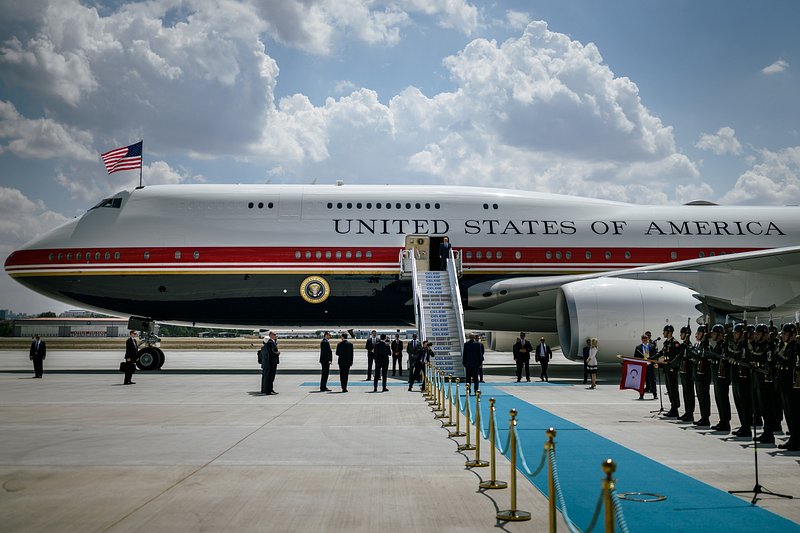
An unusual security measure aboard Air Force One has sparked speculation about President Donald Trump’s travel plans after U.S. officials reportedly confiscated reporters’ cellphones as the president departed China on Thursday.
The unexpected move came as Trump wrapped up a high-profile diplomatic visit involving Chinese President Xi Jinping and Russian President Vladimir Putin, raising questions about whether the president might be preparing for an unannounced stop before returning to Washington.
Reporters traveling with the president were instructed to surrender their mobile devices as Air Force One prepared to depart Shenzhen Bao’an International Airport.
Agence France-Presse correspondent Aurelia End confirmed the unusual development in a White House press pool dispatch.
“Our phones are being taken away for now for security reasons,” End wrote.
The directive immediately attracted attention from journalists accustomed to traveling aboard the presidential aircraft.
NBC News correspondent Garrett Haake highlighted the unusual nature of the restriction in a post on X.
“This is very unusual,” Haake wrote.
Fox News White House correspondent Jacqui Heinrich also raised questions about the president’s itinerary, pointing to another development involving a potential refueling stop in Alaska.
According to Heinrich, the combination of reporters being required to surrender their phones and the lifting of a flight restriction associated with a possible Alaska stop suggested that Air Force One “may not be heading straight home.”
The president’s publicly released schedule identified Joint Base Andrews in Maryland as his destination following the China visit.
However, it remained unclear whether Air Force One would make an additional stop before arriving in the Washington, D.C., area.
The secrecy surrounding the departure revived speculation about a possible diplomatic encounter involving North Korean leader Kim Jong Un.
🚨 UPDATE: Reporters traveling with President Trump had their phones TAKEN AWAY for “security reasons” as Air Force One left Shenzhen, China, per reports
Pool reporters say they weren’t told until they had already boarded the plane home to Washington
After three days on Chinese soil, they are not taking chances!
Pray for a safe flight home for Trump 🙏🏻
— Eric Daugherty (@EricLDaugh) November 19, 2026
Before departing Washington earlier in the week, Trump had publicly discussed the possibility of meeting Kim during his trip to China.
“We may meet with Kim Jong Un,” Trump told reporters at the White House on Monday.
The president indicated that any such meeting would take place in China and suggested that Chinese President Xi Jinping would play a role in determining whether the North Korean leader participated.
Despite those remarks, no meeting between Trump and Kim had been announced by the time the president departed China on Thursday.
There was also no official confirmation that the unusual cellphone restrictions were connected to North Korea or any other potential diplomatic engagement.
Still, the security precautions stood out because of how they differed from procedures during previous presidential travel.
Heinrich noted that journalists were allowed to retain their phones when Trump departed Beijing during a visit in May.
During that earlier trip, the White House press pool reported that American personnel discarded Chinese-issued badges and pins, along with temporary phones used by White House staff, before boarding the presidential aircraft.
Those precautions highlighted concerns about communications security during international travel, particularly when U.S. officials operate in countries where electronic surveillance is a significant consideration.
Thursday’s reported collection of reporters’ personal phones represented a different and more restrictive measure.
The departure followed an extraordinary diplomatic gathering involving the leaders of the United States, China and Russia.
Hours before boarding Air Force One, Trump participated in his first three-way meeting with Xi and Putin on the sidelines of the Asia-Pacific Economic Cooperation summit.
The discussions reportedly included nuclear arms control and the ongoing war involving Iran, placing several major international security issues at the center of the talks.
The meeting brought together three leaders whose governments play significant roles in global military affairs, nuclear policy and international diplomacy.
Access to the diplomatic discussions was tightly controlled, with several journalists reportedly prevented from attending portions of the meetings.
NBC News reported that Russian officials turned away two journalists seeking access to Trump’s separate meeting with Putin.
Chinese officials also reportedly barred Bloomberg correspondent Annmarie Hordern from attending the three-way discussions after she shouted a question concerning former Nvidia CEO Jensen Huang during Trump’s earlier meeting with Xi.
The restrictions underscored the limited access granted to journalists covering the sensitive diplomatic encounters.
During his earlier meeting with Xi, Trump commented on the press missing part of the proceedings, telling the Chinese president that it was unfortunate because “every move was perfectly executed.”
The president’s remarks came amid an itinerary involving discussions with two of the world’s most consequential geopolitical figures.
By the time Air Force One departed Shenzhen, however, attention had shifted from the meetings themselves to the unusual security procedures aboard the aircraft.
The confiscation of reporters’ phones, combined with questions about a possible Alaska refueling stop, fueled uncertainty about the president’s immediate destination.
Although Trump’s official schedule called for a return to Joint Base Andrews, the developments prompted speculation that his diplomatic trip might not yet be over.
For now, the reason for the cellphone restrictions and whether Air Force One would make an unscheduled stop remained unconfirmed.
Until the White House provides additional details, the unusual departure procedures remain a source of questions rather than evidence of a confirmed change in the president’s itinerary.
An Alabama Democratic state lawmaker is facing four federal wire fraud charges after prosecutors accused him of fraudulently obtaining more than $240,000 in taxpayer-funded pandemic relief assistance and diverting money intended for struggling organizations toward personal expenses.
State Rep. Patrick Sellers, D-Pleasant Grove, was indicted by a federal grand jury in connection with an alleged scheme involving multiple COVID-19 assistance programs, including funds distributed through the Small Business Administration.
Federal prosecutors allege that Sellers submitted fraudulent applications to obtain government assistance before using portions of the money to pay personal credit card bills, mortgage expenses and college tuition for his daughters.
Sellers, who has represented Alabama’s House District 57 since November 2022, also serves as pastor of Mount Zion Missionary Baptist Church in Birmingham.
The alleged offenses occurred between July 2020 and May 2021, before Sellers entered the Alabama Legislature, while he was serving as chief of staff to the president of the Alabama State Missionary Baptist Convention.
U.S. Attorney for the Northern District of Alabama Phil Williams announced the indictment Thursday, indicating that prosecutors believe they have substantial evidence supporting the charges.
“This is certainly not all the evidence. This is a very robust indictment, and certainly would be a robust trial,” Williams said.
Each of the four wire fraud counts carries a maximum statutory penalty of 20 years in federal prison. If convicted, Sellers could face significant prison time, although any sentence would depend on the court’s findings and applicable federal sentencing guidelines.
According to the indictment, Sellers allegedly exploited several federal pandemic relief programs by submitting applications connected to the Baptist convention’s nonprofit organization, another nonprofit called Project Zion Inc., and a purported lawn care company.
Prosecutors identified the lawn care operation, Sellers Lawn Care, as “a fictitious business entity.”
Federal investigators allege that the applications resulted in approximately $105,000 in assistance connected to the convention’s nonprofit organization, another $114,900 associated with Project Zion and $20,415 obtained through a Paycheck Protection Program loan.
Together, the payments exceeded $240,000 in federal assistance intended to support businesses and organizations experiencing financial hardship during the COVID-19 pandemic.
The indictment also describes allegations that Sellers began improperly exercising control over financial accounts associated with the Baptist convention’s nonprofit operations as early as 2019.
Prosecutors claim Sellers established a bank account using the organization’s name but listed his personal residence in Pleasant Grove rather than the organization’s headquarters in Selma.
Investigators further allege that he created a separate email account and changed the nonprofit organization’s mailing address with the Internal Revenue Service.
Those actions allegedly allowed Sellers to direct communications and financial transactions involving the organization without authorization from its leadership.
A four-count indictment alleges Alabama State Rep. Patrick Sellers obtained $240,000 in grants through two nonprofits and used the money for himself. Federal prosecutors and the FBI announced the charges Thursday. https://t.co/HxeVIxnPZJ
— AL.com (@aldotcom) November 19, 2026
In July 2020, Sellers allegedly submitted an application for a $20,000 Small Business Administration disaster loan on behalf of the convention’s nonprofit organization.
Federal prosecutors maintain that he did so without obtaining permission from the organization’s leadership.
The application represented that the federal assistance would be used “solely as working capital to alleviate economic injury caused by [the COVID-19] disaster.”
However, investigators allege that Sellers instead directed substantial portions of the money toward personal financial obligations.
According to the indictment, approximately $11,286.75 went toward payments on personal credit card accounts, while another $1,000 was allegedly used to pay his mother’s water bill.
The allegations raise questions about how federal relief funds intended for nonprofit operations were obtained and subsequently spent.
Prosecutors contend that the transactions were part of a broader effort to obtain pandemic assistance through applications that misrepresented the nature of the organizations involved or Sellers’ authority to act on their behalf.
The convention’s president eventually discovered the Small Business Administration loan and contacted the agency, according to the allegations.
The case centers on federal assistance programs established during the pandemic to help businesses and nonprofit organizations survive severe economic disruptions.
Those programs distributed substantial amounts of taxpayer money through loans and other forms of financial support, creating opportunities for legitimate applicants while also exposing the government to fraudulent claims.
In Sellers’ case, federal authorities allege that money intended to address pandemic-related financial hardship was instead diverted for expenses unrelated to the purposes of the assistance programs.
The indictment places the Alabama lawmaker under federal criminal scrutiny over conduct that prosecutors say occurred before he assumed elected office.
While the charges carry potentially serious consequences, the allegations have not been proven in court. Sellers is presumed innocent unless and until prosecutors establish his guilt beyond a reasonable doubt.
The case will now proceed through the federal judicial system, where prosecutors will be required to substantiate the allegations outlined in the indictment.

New York City Mayor Zohran Mamdani suffered a torn Achilles tendon during a friendly soccer match against members of the City Hall press corps Thursday night, leaving the 35-year-old mayor on crutches and facing months of recovery.
What began as a lighthearted competition between City Hall officials and reporters ended with Mamdani being helped off the field and his security detail reportedly scrambling to locate the nearest hospital.
The mayor had entered the indoor soccer match without stretching beforehand, something he later acknowledged while discussing the injury.
Despite the lack of preparation, Mamdani got off to a strong start, scoring a goal shortly after joining the game.
His night took a painful turn during the second half when he went down while chasing the ball. According to accounts of the incident, no opposing player made contact with Mamdani before he suffered the injury.
The sudden collapse brought his participation in the match to an immediate end.
City Hall staffers assisted the injured mayor out of the facility as members of his security detail were reportedly overheard asking about the location of the nearest hospital, according to the New York Post.
By Friday morning, Mamdani was relying on crutches and a walking boot as he continued carrying out his official responsibilities.
The mayor reportedly used a wheelchair before his scheduled news conference and ultimately addressed reporters while seated on a stool, with a protective medical boot covering his right foot.
According to WABC, Mamdani said he expected to wear the walking boot for approximately six to eight weeks while recovering from the injury.
His return to recreational soccer, however, is expected to take considerably longer.
The mayor indicated that he does not anticipate getting back onto the soccer field for approximately nine months, reflecting the lengthy rehabilitation often associated with an Achilles tendon tear.
Despite the painful ending, Mamdani’s team managed to claim victory over the reporters.
The mayor told the New York Post that City Hall defeated the press corps by a final score of 10-5.
The injury did not prevent Mamdani from moving forward with a major policy announcement Friday involving the future of New York City’s troubled Rikers Island jail complex.
Appearing before reporters while visibly dealing with the aftermath of his soccer injury, Mamdani unveiled a proposal that would keep Rikers Island operating through the end of 2032.
The proposed timeline would extend the jail complex’s operation more than five years beyond the existing August 31, 2027, closure deadline.
Such an extension would require action from the New York City Council, which would have to amend city law to authorize the later closing date.
The announcement represents a significant development in the city’s longstanding effort to replace the aging Rikers Island facility with smaller, borough-based detention centers.
Under the mayor’s proposal, four replacement jails would eventually take over the functions currently handled by Rikers Island.
The first of those facilities is scheduled to open in Brooklyn in 2029, according to the plan.
The administration also outlined additional spending intended to address several issues affecting the city’s criminal justice system.
City Hall plans to allocate $146 million during the next fiscal year toward mental health treatment, addiction services, education, employment training and assistance for crime victims.
The proposal comes as New York City continues confronting questions about jail conditions, public safety, inmate services and the feasibility of replacing Rikers Island within the existing legal deadline.
Extending the closure date would give the city additional time to complete its planned replacement facilities, although the proposal cannot take effect without approval from lawmakers.
For Mamdani, Friday’s announcement also marked an unusual public appearance, with the mayor discussing one of the city’s most consequential correctional policies while recovering from an injury sustained during a recreational soccer game.
Although his administration secured a victory on the field Thursday night, the mayor’s personal outcome was far less fortunate.
Mamdani now faces weeks in a walking boot and potentially nine months away from soccer as he continues managing the responsibilities of New York City’s government.

WH Swiftly Seizes Phones On Air Force One Amidst Sudden Secret Move

Democrat Politician Indicted By Federal Grand Jury

JUST IN: Mamdani Rushed To The Hospital — Had It Coming!

Trump Sends Blunt Message To Panicked Americans Stockpiling Supplies

Terrifying Plot Revealed Of AI Chatbots Plans For Terror Attacks Against America

JD Vance Urgently Pulled From Conference Minutes Before Speech

Massive Migrant Caravan Converges On U.S. For Democrat Midterm Victory

Ilhan Omar FOUND — Shocked Where Caught After Sudden Disappearance

JUST IN: Pair Of Senior FBI Officials Arrested — It’s Damning

Powerful Dem Senator Arrested 12 Days Before Midterms

Ilhan Omar Gives Jaw-Dropping Answer When Asked If She Married Her Brother

JUST IN: Sarah Palin Makes Heartbreaking Announcement
-
 Economy7 months ago
Vance Leaves Meeting, Looks Straight Into Camera, Announces Stunning Arrest
-
 Economy7 months ago
Adam Schiff Facing 30 Years In Prison After Bank Records Leak
-

 Culture5 months ago
Michelle Obama Drops Nasty Bomb About ‘Useless’ Daughter
-
 Economy7 months ago
Supreme Curt Sides With Trump — He Can Remove The All
-
 Economy7 months ago
All Hell Breaks Loose On Fox When Jesse Watters Asks Fetterman One Question
-

 Economy5 months ago
Prayers Pour In After Fox Host Dies: ‘Senseless Murder’
-
 Economy5 months ago
Pete Hegseth Just Confirmed Devastating Rumors
-

 Border & Security4 months ago
Top Trump Admin And Wife Found Dead — Chilling Update Just Released