
Latest
Report: Chinese propaganda, Singham network, foreign dark money linked to campaigns against data centers

On Sunday, CodePink, a far-left, pro-China, pro-communism nonprofit activist group, published a video on Instagram attacking a proposed data center project in Utah backed by investor Kevin O’Leary.
According to a new report, obtained by Fox News Digital, that wasn’t a coincidence.
The report, “Foreign Influence in the Campaign against American AI,” by the Bitcoin Policy Institute, alleges that there are “three vectors of foreign influence converging on the push to block U.S. AI data center construction.”
They include a nonprofit network funded by tech tycoon Neville Roy Singham, a U.S. expatriate living in Shanghai promoting Chinese propaganda; Chinese Communist Party state media; and dark money funding tied to foreign billionaires including Swiss billionaire Hansjörg Wyss and British billionaire Alan Parker.
The report alleges nonprofits funded by Singham — including CodePink — have spent years fueling opposition to U.S. AI infrastructure and data center expansion in coordination with Chinese propaganda narratives and foreign-funded activist networks. As reported, in February 2017, Singham married Jodie Evans, the co-founder of CodePink in a lavish wedding in Jamaica, and, according to a Fox News Digital investigation, Singham pumped $285 million into six nonprofits over the next several years, using a series of shell companies and a donor-advised fund established at a philanthropy arm of Goldman Sachs. A spokesman for Goldman Sachs told Fox News Digital that the company “terminated” Singham’s donor-advised fund in early 2024.
Still, the network of organizations that Singham has funded have continued to act as proxies for the propaganda of the Chinese Communist Party.
On March 25, amid campaigns by Singham organizations against U.S. technology firms, Sen. Bernie Sanders and Rep. Alexandria Ocasio-Cortez introduced the “AI Data Center Moratorium Act.” Weeks later, on April 29, Sanders hosted a Capitol Hill event titled “The Existential Threat of AI.”
According to the report, two of the four panelists at that event were affiliated with the Chinese government: Zeng Yi, founding dean of the Beijing Institute of AI Safety and Governance, and Xue Lan, a counselor of China’s State Council and chair of China’s National AI Governance Committee.
Singham, Evans, Wyss, Parker Sanders, Ocasio-Cortez didn’t respond to requests for comment. The organizations named in the report didn’t respond to requests for comment.
BERNIE SANDERS’ PLANS TO SCHMOOZE WITH TOP BEIJING AI EXPERTS IGNITES BACKLASH: ‘HOLY SH–‘
The report states that, using a U.S. Senate platform, Xue argued that the U.S.-China AI race was “an inaccurate narrative” and promoted “safe zones” of cooperation on AI governance, messaging the report says paralleled years of Chinese state media narratives surrounding AI policy and American technological development.
Sam Lyman, head of research at the Bitcoin Policy Institute and a former senior speechwriter for Treasury Secretary Scott Bessent, said, “Ensuring that AI is safe and empowers American workers must be a top priority for US policymakers. But the discussion about AI safety should not be influenced by geopolitical rivals, especially China, whose leaders have publicly stated their intentions to accelerate AI development to ‘gain the initiative in global science and technology competition.’”
“Depending on advances in this field, there may come a time when the United States and China must engage in bilateral negotiations to ensure the safe development of AI,” Lyman said. “But until then, an honest conversation about AI safety requires filtering any foreign influence. This report provides the transparency citizens and lawmakers need to see who is funding and influencing the campaigns shaping the AI policy debate.”
STEVE FORBES: THE AI COLD WAR HAS BEGUN AND AMERICA CANNOT AFFORD TO LOSE
The convergence of interest groups opposing data centers isn’t a coincidence, the report alleges.
“These events did not take place in isolation,” says the report. “They were the culmination of a multi-year influence campaign against American AI conducted across three vectors of foreign influence.”
The report specifically alleges that Beijing’s state-run media outlets — including CGTN, China Daily and Global Times — have pushed anti-data-center narratives inside the United States while China simultaneously subsidizes domestic AI infrastructure development.
“The asymmetry is what gives the operation away,” the report argues. “While Beijing’s state media warns American audiences that data centers are environmentally and economically dangerous, the Chinese state subsidizes up to half of the energy costs of its own AI data center operators.”
The report further alleges that the Singham network “has spent nearly five years producing parallel domestic content opposing U.S. AI infrastructure, AI labs, and AI export controls.”
It points to multiple examples involving organizations linked to the network.
GORDON CHANG: A LOT OF OUR ANTI-AMERICAN PROTESTS ARE MADE IN CHINA
In January 2026, CodePink published an article titled “The War Intervention: AI, Data Centers, and the Environment,” directly targeting U.S. AI data centers, including Meta’s Hyperion project in Louisiana and Meta Cheyenne in Wyoming, while framing the fight as opposition to “the new Cold War on China.”
The report also cites Tricontinental: Institute for Social Research, a Singham-funded think tank, for repeatedly opposing U.S. semiconductor export controls and criticizing efforts to limit China’s AI development.
On March 27, Tricontinental published an article, “Breaking the Stranglehold: How China Is Shattering US Technological Hegemony,” arguing against U.S. AI chip restrictions and portraying American export controls as an attempt to suppress China’s rise.
That same day, Peoples Dispatch — which is also part of the Singham ecosystem — published “Kill Chain: Silicon Valley, AI, and the war on Iran,” attacking AI companies including Anthropic and Palantir Technologies. The report describes the same-day publication pattern across affiliated outlets as evidence of coordinated messaging operations.
By May 1, CodePink published an article, “The Dark Side of the Data Center Boom,” adding to the cacophony of coordinated protests against U.S. data centers.
The House Ways and Means Committee, House Oversight Committee and the House Select Committee on the Chinese Communist Party are investigating whether some of the nonprofits should register under the Foreign Agents Registration Act, or FARA. The House Ways and Means Committee has issued letters to Singham-funded organizations, seeking internal documents related to their funding, operations and connections to Singham and the Chinese Communist Party.
On foreign funding, the report alleges that charitable organizations tied to Wyss and Parker have routed billions of dollars into U.S.-based advocacy infrastructure now aligned against AI infrastructure projects and data centers.
It specifically highlights a Dec. 8, 2025, letter organized by Food & Water Watch, a nonprofit, calling for a national moratorium on new AI data centers. According to the report, about 230 organizations signed the letter, including groups receiving funding from networks linked to Wyss and Parker.
The report notes that the Sanders-Ocasio-Cortez moratorium legislation was introduced 107 days after the coalition letter was circulated.
“That kind of efficiency typically distinguishes coordinated advocacy infrastructure from spontaneous grassroots opposition,” the AI Policy Institute states.
The report argues that “ensuring that AI is safe and empowers American workers must be a top priority for U.S. policymakers,” but says the debate over AI safety and data centers “should not be influenced by a geopolitical rival.”
In its conclusion, the report frames the debate in stark geopolitical terms, arguing that “the choice facing policymakers is not between AI or no AI but between American AI or Chinese AI.”
By early afternoon on Monday, the CodePink video opposing the Utah data center project had acquired 356 likes, many of them from the pro-China, pro-communist activist ecosystem.

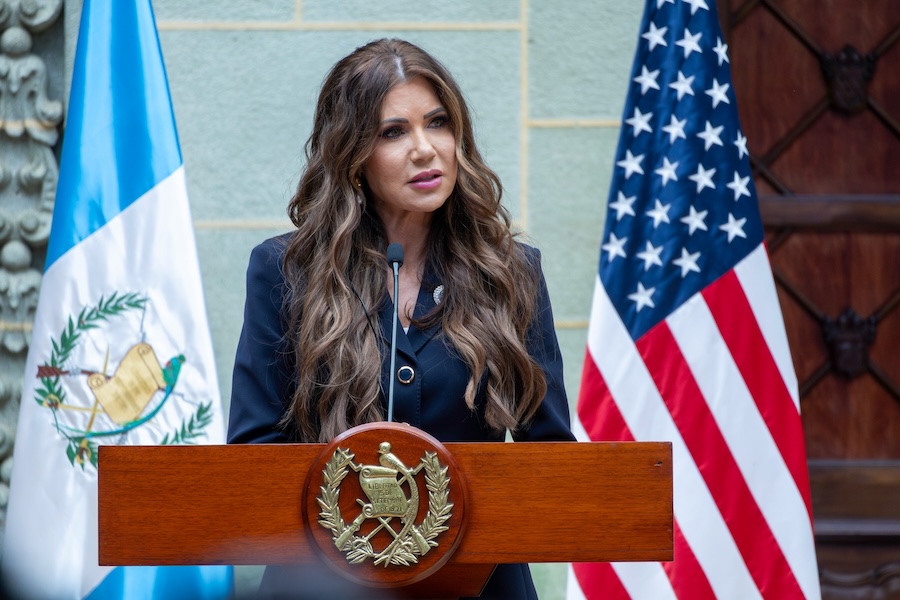
After months of public scrutiny, damaging revelations and signs of turmoil behind the scenes, a major change in former Homeland Security Secretary Kristi Noem’s personal life has now become official.
Noem has filed for divorce from her husband, Bryon Noem, bringing their marriage of more than three decades toward an end.
Court documents filed in South Dakota cite “irreconcilable differences” as the reason for the split. The filing was submitted April 6 but did not appear on Hamlin County’s online court system until Monday.
The couple married in 1992 and share three adult children.
The filing follows months of controversy surrounding Bryon’s reported private online activity, including allegations of explicit exchanges with adult models and participation in an online cross-dressing fetish community.
Photos published earlier this year reportedly showed Bryon wearing pink shorts, a crop top and exaggerated prosthetic breasts as part of what was described as a “bimbofication” fetish.
He was also reported to have sent at least $25,000 to online models through PayPal and Cash App while allegedly using the alias “Jason Jackson.”
One model said she discovered his identity after accidentally calling a number and hearing a voicemail greeting for Noem Insurance, the South Dakota insurance agency Bryon operates.
A spokesman for Kristi said at the time that she was “devastated” and that the family had been “blindsided” by the revelations.
Asked about the divorce proceedings by a South Dakota news outlet, Bryon offered little indication that he planned to discuss the matter publicly.
“I can’t comment right now.”
For members of Kristi’s family, however, the split apparently did not come as a surprise.
Kristi’s mother, Corinne Arnold, said in July that her daughter had already told relatives she intended to end the marriage and had hired an attorney in Sioux Falls.
“It has been difficult, but we knew this was coming, that they were going to get divorced,” Arnold told the Daily Mail.
“I feel bad, sick that they’re getting a divorce, but what else can you do?” she added.
By that point, Bryon had reportedly moved out of the couple’s Castlewood home and was living approximately 20 miles away.
The marriage had also faced years of public speculation surrounding Kristi’s relationship with longtime political adviser Corey Lewandowski.
Both Noem and Lewandowski have denied allegations that they had a romantic affair, and no independently verified evidence has publicly established that such a relationship occurred.
The two were photographed together in Minnesota in August, including at a lunch and while cycling near Lake Minnetonka.
Their professional relationship had previously attracted scrutiny during Noem’s tenure at the Department of Homeland Security, where Lewandowski served as an unpaid adviser.
During a congressional hearing in March, Noem was directly questioned about allegations involving Lewandowski and dismissed the questioning as tabloid material.
The turmoil surrounding her marriage intensified around the same period that she left the Department of Homeland Security and later assumed a State Department position as special envoy for the Shield of the Americas.
President Donald Trump also publicly reacted after reports concerning Bryon’s alleged online activity surfaced.
“Wow, well, I feel badly for the family if that’s the case, that’s too bad.”
Noem later returned to Pierre, South Dakota, for the unveiling of a life-sized bronze statue honoring her tenure as governor.
Her mother and grandchildren attended the ceremony.
Bryon did not.
After months of reported separation, family acknowledgment of the impending split and intense public attention surrounding the couple’s marriage, the matter has now moved into court.
More than three decades after Kristi and Bryon Noem married, their divorce filing makes the breakup official.
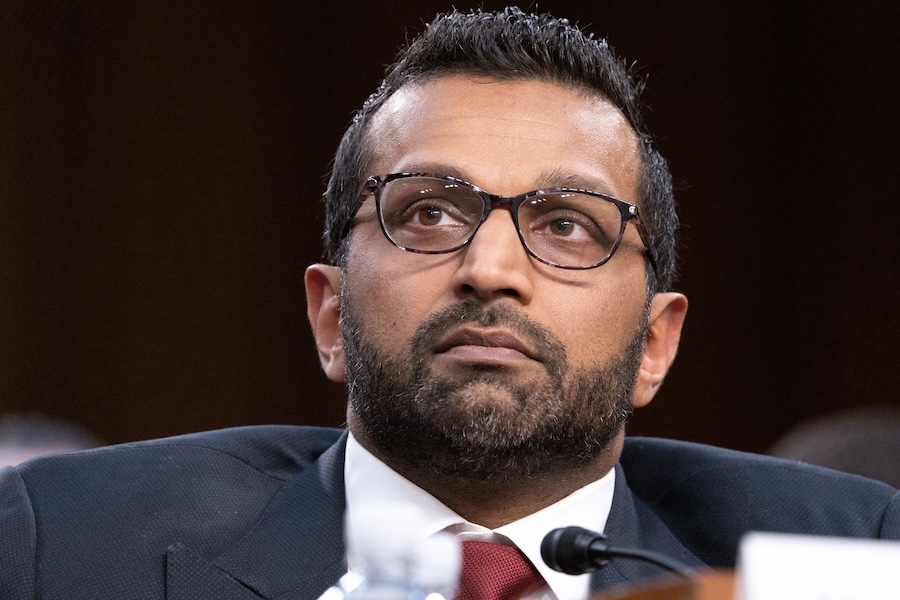
One of FBI Director Kash Patel’s top deputies is abruptly leaving the bureau, creating another opening at the highest levels of an agency already undergoing major organizational changes.
Andrew Bailey, the former Missouri attorney general who has served as one of the FBI’s co-deputy directors, announced Monday that he is stepping down after roughly a year at the bureau and returning home to his family in Missouri.
His final day will be Friday, Oct. 2.
“With great pride in what we have accomplished, I am announcing that I am stepping down to return to my family in Missouri,” Bailey said.
Bailey joined the FBI in 2025 after leaving the Missouri attorney general’s office and became part of an unusual leadership structure under Patel, serving alongside another co-deputy director.
His departure comes as Patel continues implementing major personnel and organizational changes at the FBI amid longstanding political disputes over the bureau and allegations of political bias in federal law enforcement.
Bailey, a Republican who previously served as Missouri’s top law enforcement official, has been a vocal supporter of Patel’s efforts to reshape the agency.
And despite his sudden departure, Bailey made clear that he continues to support Patel and the direction of the bureau.
“I am confident Director Patel will continue to reform the FBI, combat violent crime, defend the homeland, ensure strong organizational accountability, and restore public trust in this institution of excellence,” he added.
Bailey also thanked President Donald Trump, Attorney General Todd Blanche and Patel for giving him the opportunity to serve.
During his tenure, Bailey became a visible member of the FBI’s leadership team, appearing alongside federal and state officials during law enforcement operations and promoting the bureau’s emphasis on combating violent crime.
He also participated in major investigations and enforcement initiatives as Patel’s leadership team sought to redirect bureau resources and address concerns among conservatives who had become deeply skeptical of the FBI.
The bureau has undergone extensive personnel and organizational changes since Patel became director in February 2025.
Patel has argued that the FBI needs to move away from what he describes as politicized enforcement and refocus the bureau on traditional law enforcement priorities, including violent crime, counterterrorism and threats to national security.
Those efforts have made Patel’s tenure closely watched in Washington as the Trump administration pursues broader changes across the federal government.
Bailey’s resignation now creates another vacancy near the top of the FBI less than two years into Patel’s tenure.
But Bailey said his decision was personal.
According to his public announcement, he is leaving Washington to return to Missouri and spend more time with his family.
Nothing in Bailey’s announcement indicated that he had been forced from his position or that his departure resulted from a dispute with Patel.
Instead, Bailey used his exit announcement to praise the FBI’s work during his tenure and publicly reaffirm his confidence in Patel.
His departure nevertheless removes a prominent member of Patel’s leadership team at a consequential moment for the bureau.
With Bailey preparing to leave Washington on Friday, Patel will now move forward without one of the senior officials who helped carry out the FBI overhaul during its first year under his leadership.

Fox News is bringing one of former New York Gov. Andrew Cuomo’s most prominent former aides onto its platform — a move that immediately triggered a furious response from one of the network’s own former personalities.
Melissa DeRosa, Cuomo’s longtime top lieutenant and former secretary to the governor, has been hired as a Fox News contributor and will appear on the network’s new weekly podcast, “The Girls.”
DeRosa will make her debut when the program premieres Oct. 1, Fox News Media announced Monday.
But the announcement quickly reopened one of the most bitter controversies surrounding Cuomo’s administration: New York’s handling and reporting of nursing home deaths during the COVID-19 pandemic.
Former Fox News meteorologist Janice Dean blasted the decision.
Dean’s mother-in-law and father-in-law died of COVID-19 in 2020 after living in New York long-term care facilities. Their deaths turned Dean into an outspoken critic of Cuomo and his administration as she pushed for answers about the state’s nursing home policies.
Following news of DeRosa’s Fox role, Dean unloaded.
“Melissa DeRosa helped smear the women who came forward about Andrew Cuomo’s harassment, and played a hand in undercounting nursing home deaths during COVID. Also tried to silence my advocacy.”
DeRosa served as secretary to the New York governor, becoming the first woman to hold the powerful position.
She resigned in August 2021 as sexual harassment allegations engulfed Cuomo’s administration.
But DeRosa had already become a central figure in the controversy surrounding the Cuomo administration’s handling of nursing home death information.
Months before her resignation, DeRosa acknowledged during a private call with Democratic state lawmakers that the administration had withheld nursing home death data while facing concerns about a possible investigation by President Donald Trump’s Justice Department.
The February 2021 disclosure intensified scrutiny over New York’s accounting of COVID-19 deaths among nursing home residents.
At the time, the state’s nursing home tally did not include residents who died after being transferred from nursing homes to hospitals, leaving thousands of deaths outside that particular count.
DeRosa later maintained that the administration had placed state lawmakers’ request for the information on hold while it prioritized responding to the federal inquiry.
The controversy did not end there.
A New York State Assembly investigation released in November 2021 concluded that Cuomo had not been fully transparent about nursing home resident deaths.
The investigation also concluded that Cuomo sexually harassed women and used state resources in connection with the production and promotion of his pandemic memoir.
Now DeRosa is returning to the political-media spotlight through Fox News.
She will appear on “The Girls,” a new weekly podcast featuring a rotating group of female co-hosts discussing politics, careers, family life and pop culture.
The premiere will also feature Fox personalities Rachel Campos-Duffy, Harris Faulkner and Kat Timpf.
New episodes are scheduled to be released Thursdays on YouTube, Spotify and Apple Podcasts.
The launch will also bring former ESPN personality Sam Ponder back into the spotlight following her 2024 departure from the sports network.
Ponder, the former host of “Sunday NFL Countdown,” will join DeRosa and the Fox personalities for the premiere episode.
But it is DeRosa’s addition that has already generated controversy before the first episode even airs.
For Dean, the issue is deeply personal.
She spent years publicly challenging Cuomo’s administration over its handling of nursing homes after losing two family members during the pandemic.
Now the former governor’s onetime top aide is joining the same media organization where Dean became one of the most visible critics of that administration.
And Dean made clear exactly what she thinks of the decision.

Kristi Noem Shares Huge Relationship News After Months Of Speculation

BREAKING: FBI Rocked By Sudden Shocking Resignation

Fox News Under Fire After Hiring Notorious Democrat; Ex-Host Explodes

Fireworks Erupt On Capitol Hill After 52-45 Vote For Trump!

NEW: Justice Alito Abruptly Reverses Course In Key SCOTUS Case

National Emergency Declared — Trump Called In

‘The Five’ Gets Emotional As Greg Gutfeld Announces Tragic News

Joe Biden’s Daughter Just Dropped Massive Public Bombshell On Her Dad

Removed From the Country — Ilhan Omar Hit With Horrid News

Obama Calls It QUITS After Wild Video Goes Viral

Get Ready — Mike Pence Makes Stunning 2028 Announcement

Schumer Loses! Court Sides With Trump In Historic Move
-
 Economy6 months ago
Vance Leaves Meeting, Looks Straight Into Camera, Announces Stunning Arrest
-
 Economy6 months ago
Adam Schiff Facing 30 Years In Prison After Bank Records Leak
-
 Economy6 months ago
Supreme Curt Sides With Trump — He Can Remove The All
-
 Culture3 months ago
Michelle Obama Drops Nasty Bomb About ‘Useless’ Daughter
-
 Economy6 months ago
All Hell Breaks Loose On Fox When Jesse Watters Asks Fetterman One Question
-
 Economy4 months ago
Prayers Pour In After Fox Host Dies: ‘Senseless Murder’
-

 Latest3 months ago
Fox News Stuns With Announcement About 5 Fired Hosts
-
 Border & Security2 months ago
Top Trump Admin And Wife Found Dead — Chilling Update Just Released