
Latest
Several Ex-Presidents BUSTED After Trump FINALLY Declassifies Bombshell Doc

A massive new release of once-classified intelligence is reopening one of the most consequential questions surrounding September 11: How much did the U.S. government know about Osama bin Laden’s plans to strike America before the attacks occurred?
The CIA has released 71 President’s Daily Brief products from the years surrounding 9/11, exposing a trail of warnings delivered during the administrations of both President Bill Clinton and President George W. Bush.
The documents don’t show that either president was handed the blueprint for what ultimately happened on Sept. 11, 2001.
But they do reveal something striking: Years before hijacked passenger jets slammed into the World Trade Center and Pentagon, intelligence officials were already warning about bin Laden, attacks inside the United States, aircraft hijackings and Al Qaeda operatives potentially operating on American soil.
And some of those warnings were remarkably specific.
One of the most alarming came on Dec. 4, 1998.
The briefing prepared for Clinton carried the title:
“Bin Ladin [sic] Preparing To Hijack US Aircraft.”
The intelligence assessment warned:
“Some members of the Bin Ladin network have received hijack training, according to various sources. Bin Ladin could be weighing other types of operations against US aircraft.”
That wasn’t all.
The same document raised the possibility that an operation could be approaching quickly, stating:
“Bin Ladin might implement plans to hijack a US aircraft before the beginning of Ramadan on 20 December and that two members of the operational team had evaded security checks during a recent trial run at an unidentified New York airport.”
The significance of those words is difficult to miss with the benefit of hindsight.
But another warning had reached the Clinton administration months earlier.
A Sept. 10, 1998, briefing described intelligence indicating bin Laden wanted to bring the fight directly onto American soil.
“Bin Ladin late last month said his preferred option is to strike the US on its own soil in Washington … the same group responsible for the US Embassy bombings in Africa Kenya and Tanzania may fly an explosive-packed airplane into a US city.”
The intelligence picture wasn’t uniformly definitive.
Some reports were explicitly regarded as questionable by the CIA.
One July briefing acknowledged that uncertainty directly:
“we have received four reports from highly questionable sources suggesting Usama [sic] Bin Ladin is making plans to conduct an attack in the United States.”
That distinction matters. Intelligence agencies routinely receive fragmentary, contradictory or unreliable information, and the newly released records do not amount to evidence that officials possessed advance knowledge of the specific 9/11 operation.
But the warnings continued.
By February 2000, intelligence reporting was identifying possible symbolic targets inside the United States, including the Statue of Liberty.
Then the presidency changed hands.
The warnings did not disappear.
After George W. Bush took office, intelligence officials continued tracking the threat from bin Laden and Al Qaeda.
Among the documents is perhaps the most famous pre-9/11 presidential intelligence briefing of them all:
“Bin Laden Determined to Strike in US.”
That August 2001 briefing would become a central focus of investigations after the attacks.
It warned that Al Qaeda had an existing presence inside the country:
“Al-Qa’ida [sic] members-including some who are US citizens—have resided in or traveled to the US for years, and the group apparently maintains a support structure that could aid attacks.”
The briefing also described troubling activity occurring inside the United States.
“After US missile strikes on his base in Afghanistan in 1998, Bin Ladin told followers he wanted to retaliate in Washington,” the document states, noting the FBI found “patterns of suspicious activity in this country consistent with preparations for hijackings or other types of attacks, including recent surveillance of federal buildings in New York.”
Again, none of that amounted to the operational blueprint for what would happen on Sept. 11.
The intelligence did not identify the World Trade Center and Pentagon as the eventual targets, nor did it lay out the complete plan involving four hijacked passenger jets.
And the reliability of some individual reports remained in doubt.
A July 21, 1999, CIA memo, for example, reported a claim that bin Laden’s organization had “made a dry run of a bombing of the FBI headquarters” in Washington and suggested an attack could occur “soon.”
But CIA analysts simultaneously warned they had “reservations about the source.”
The threat picture extended far beyond airplanes.
Intelligence officials were also investigating whether bin Laden was pursuing chemical, biological, radiological or nuclear capabilities.
A February 1999 document delivered another chilling assessment:
“If Bin Ladin succeeded in buying a chemical or biological weapon, his past behavior and statements indicate he would have no reservations about using it and he would begin searching for a suitable target.”
Taken together, the newly public material provides a revealing look inside the stream of intelligence reaching America’s highest levels of government before 9/11.
CIA Director John Ratcliffe announced the release as the country marked 25 years since the attacks.
“Today I authorized the release of 71 Presidential Daily Briefs to honor the lives of those killed on 9/11,” Ratcliffe said in a statement.
The records span years and show analysts repeatedly trying to understand bin Laden’s intentions from intelligence that was often incomplete, uncertain and rapidly changing.
But they also put renewed attention on a painful historical reality: warning signs existed.
Possible attacks inside America.
Hijackings.
Operatives already in the United States.
Suspicious activity potentially connected to preparations for attacks.
And even intelligence contemplating aircraft being used in attacks against American cities.
Twenty-five years after 9/11, former Bush national security adviser Condoleezza Rice publicly addressed the failure to recognize the full magnitude of the threat before it was too late.
“Those of us in authority on that day did not see the nature of the danger in time to prevent the attack of 9/11,” Rice said.
She added:
“I will always carry deep personal remorse for the pain that you, the families of the fallen, still feel, and for the trauma that our country endured.”
The newly declassified material does not establish that Clinton, Bush or their administrations knew that terrorists would hijack four airplanes on Sept. 11, 2001, or knew the specific targets, timing and mechanics of the coming attack.
What the documents do establish is that the threat from bin Laden had been occupying the attention of American intelligence officials for years.
And scattered throughout that intelligence were warnings involving some of the very elements that would ultimately define the deadliest terrorist attack ever carried out on American soil.
Twenty-five years later, those warnings are now available for the public to examine.
And they provide a stark historical record of just how difficult—and ultimately consequential—it was for the government to turn a growing collection of warning signs into an understanding of the catastrophe that was approaching.

Former Fox News personality Kimberly Guilfoyle may be leaving the Trump administration, but a new report claims the longtime Republican insider possesses a private collection of sensitive information about President Donald Trump’s family, personal relationships and political operation.
According to the Daily Mail, sources familiar with Guilfoyle’s years inside Trump’s inner circle allege that the former U.S. ambassador to Greece has kept what insiders describe as a secret “burn book,” reportedly nicknamed “The Devil Wears MAGA.”
The alleged collection has reportedly raised concerns among some Trump associates that Guilfoyle could disclose embarrassing personal details following the White House’s request for her resignation.
However, the existence of the supposed book has not been independently verified, and Guilfoyle has not publicly acknowledged possessing such material or threatened to release private information about the Trump family.
The claims surfaced amid reports that Guilfoyle’s diplomatic assignment was ending following allegations involving her financial dealings and conduct while serving in Greece.
According to the Daily Mail, some individuals close to Trump had privately argued against removing Guilfoyle from her position, citing concerns about the potential consequences of an acrimonious departure.
“Having her back in America would be a nightmare. Kimberly knows where the bodies are buried. She knows the people, the secrets, the fights, the relationships,” one unnamed source told the outlet.
“Nobody wants an angry Kimberly back home with nothing to lose.”
The remarks reflect the source’s characterization of Guilfoyle’s relationships within Trump’s political and personal circle, rather than independently established evidence that she possesses damaging information.
Guilfoyle, 57, has maintained close ties to the Trump family for years.
A former prosecutor and Fox News host, she became a prominent Republican fundraiser and political surrogate while dating Donald Trump Jr.
Their relationship lasted approximately six years, during which Guilfoyle regularly appeared at major Republican events, campaign gatherings and private functions involving the Trump family.
The couple’s engagement ended in 2024, shortly before Trump announced his intention to nominate Guilfoyle as U.S. ambassador to Greece.
According to one source quoted by the Daily Mail, the diplomatic appointment served both political and personal purposes.
“Kimberly wasn’t sent to Greece just because of her skills,” the source alleged.
“It also solved a complicated personal problem. Having her thousands of miles away worked for everyone.”
That interpretation has not been independently substantiated, and the source did not provide public evidence establishing that personal considerations influenced Trump’s appointment decision.
Guilfoyle’s departure from the administration reportedly followed scrutiny of her financial arrangements, private travel and relationships with political donors and lobbyists.
The Wall Street Journal previously reported allegations that Guilfoyle approached Republican donor Eric Deters about paying a $100,000 American Express bill while allegedly offering to facilitate access to administration officials.
Deters reportedly declined the request.
Guilfoyle’s attorneys have disputed suggestions of wrongdoing, explaining that the financial matter involved compensation she believed was owed for public appearances and speaking engagements arranged before her diplomatic nomination.
Her legal representatives have also defended her travel arrangements, maintaining that she “sought, obtained and followed State Department guidance.”
Separately, the Daily Mail reported that the State Department’s inspector general had opened an investigation into allegations involving Guilfoyle and the American diplomatic mission in Greece.
The scope and findings of any such investigation have not been established in the supplied reporting.
Sources also claimed that Trump and Secretary of State Marco Rubio were angered by the controversy surrounding Guilfoyle’s tenure.
The White House subsequently requested her resignation, bringing her diplomatic assignment toward an end.
Guilfoyle responded publicly by rejecting the allegations and emphasizing her continuing loyalty to the president.
She described the accusations against her as “false” and pledged to “vigorously defend my name, my reputation, and my integrity.”
“I have dedicated my professional life to fighting for justice, standing up for what is right, and defending the values that make America exceptional. I will not allow false accusations to define my decades of public service.”
Despite the administration’s decision to seek her departure, Guilfoyle did not publicly criticize Trump or Rubio.
Instead, she thanked them for the opportunity to represent the United States abroad and described her ambassadorial service as “the honor of a lifetime.”
She also reaffirmed her support for Trump and the America First movement.
Her public statements contrast with the anonymous claims suggesting that she might retaliate against the president’s family.
The Daily Mail’s report does not establish that Guilfoyle intends to publish a memoir, disclose private conversations or use alleged personal information to pressure anyone connected to the administration.
Nor does it establish that the rumored collection of information exists in the form described by its sources.
Nevertheless, the report has attracted attention because of Guilfoyle’s longstanding personal and political connections to the Trump family.
Her relationship with Donald Trump Jr. placed her within the family’s social circle during several consequential years in Trump’s political career.
She also participated in Republican fundraising and campaign activities, giving her familiarity with prominent donors, advisers and political allies.
Those connections provide context for the anonymous sources’ claims, but they do not verify the allegations about a secret diary or its supposed contents.
One unnamed insider offered a particularly pointed description of the concerns reportedly circulating among Trump associates.
“Keeping Kimberly happy keeps Kimberly quiet,” the source told the Daily Mail.
That statement remains an anonymous allegation about the attitudes of people within Trump’s orbit, not evidence of an actual threat by Guilfoyle.
For now, the publicly described circumstances present two distinct issues.
The first involves the allegations surrounding Guilfoyle’s diplomatic service and her legal team’s denials of improper conduct.
The second involves the Daily Mail’s unverified claims that she possesses private information that could embarrass members of the Trump family.
No public evidence presented in the supplied reporting establishes that the two matters are connected or that Guilfoyle has attempted to use personal information in response to her removal.
Her own public remarks have emphasized loyalty rather than retaliation.
Whether additional details emerge about the alleged “burn book” remains uncertain.
What is clear from Guilfoyle’s reported statements is that she intends to defend her reputation while continuing to support Trump politically.
The anonymous sources quoted by the Daily Mail suggest some associates fear a more contentious outcome, but Guilfoyle herself has given no public indication that she plans to turn against the president.
Until the alleged collection is authenticated or Guilfoyle addresses the claim directly, the supposed “Devil Wears MAGA” book remains an unverified account rather than an established political revelation.
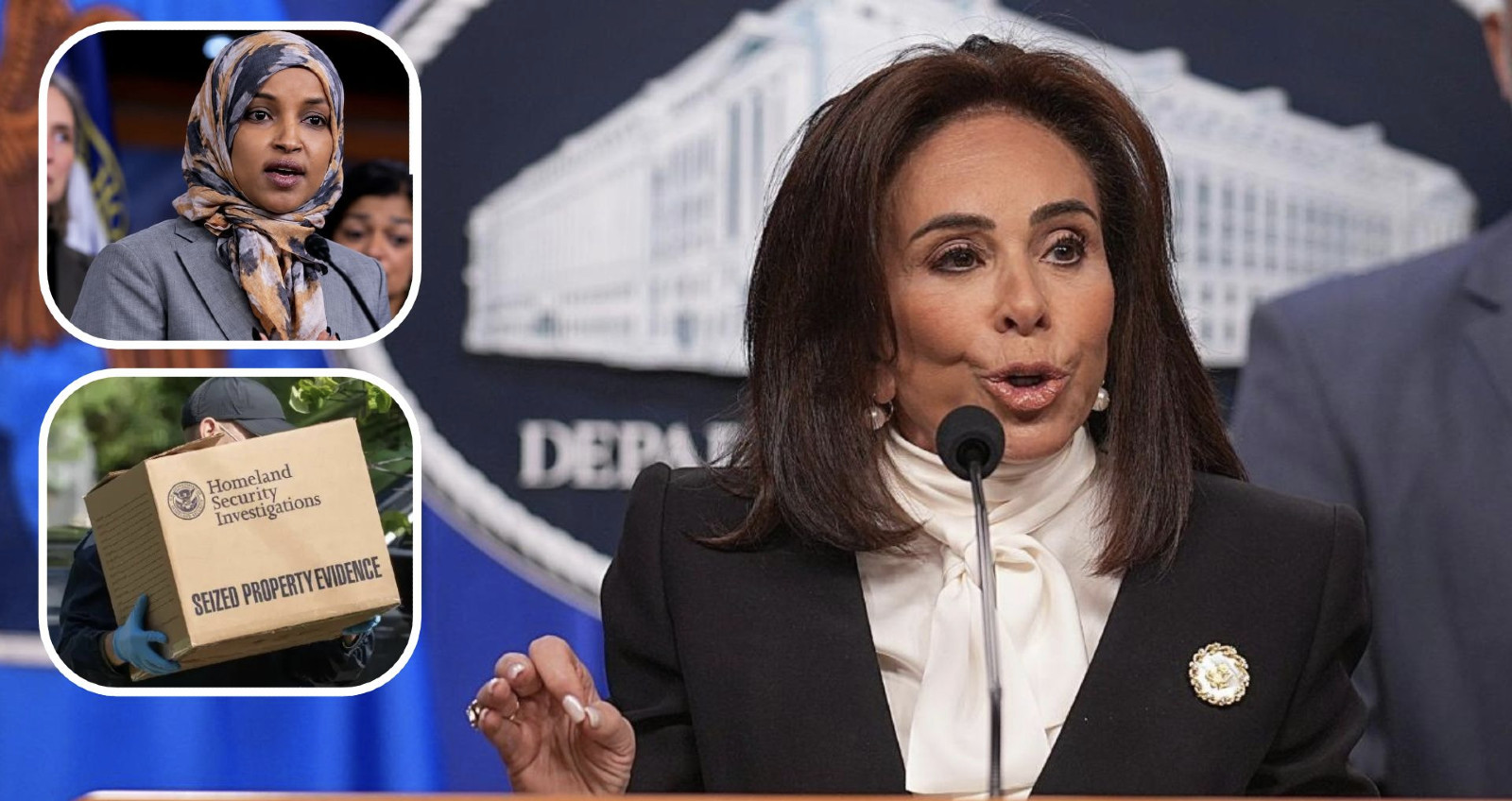
Rep. Ilhan Omar (D-Minn.) is facing additional federal scrutiny after U.S. Attorney Jeanine Pirro announced that her office is investigating the congresswoman’s financial disclosures, including questions surrounding millions of dollars in previously reported assets.
The announcement came Tuesday night during a Fox News appearance, one day after federal agents reportedly searched Omar’s Washington, D.C., residence as part of a separate investigation involving her family’s immigration history.
The two inquiries have drawn considerable attention, although authorities have not established that they are connected.
Pirro confirmed that federal prosecutors are examining Omar’s financial filings despite an earlier congressional watchdog recommendation to dismiss allegations concerning those disclosures.
“We’re looking at the facts,” Pirro said, adding that prosecutors would “follow them wherever they take us.”
The review centers on financial disclosures involving businesses connected to Omar’s husband, Tim Mynett.
According to the reporting, an earlier filing placed the couple’s reported assets within a range of approximately $6 million to $30 million.
Omar subsequently amended the disclosure to reflect substantially lower figures.
Her representatives attributed the discrepancy to accounting errors involving business liabilities that had not been properly reflected in the original paperwork.
The difference between the two sets of figures has prompted questions about how the disclosures were prepared and whether the initial valuations accurately represented the couple’s financial interests.
Congressional financial disclosure forms typically report assets within broad value ranges rather than providing precise valuations, making it difficult to determine an individual’s exact net worth from the filings alone.
The reported $6 million to $30 million range therefore should not be interpreted as a verified calculation of Omar’s personal wealth.
Nevertheless, the substantial difference between the original and amended disclosures is among the issues now reportedly receiving federal attention.
Pirro made clear that her office’s review is separate from the earlier congressional ethics process.
The Office of Congressional Conduct previously examined allegations involving Omar’s disclosures and recommended that the House Ethics Committee dismiss the matter after determining there were insufficient grounds to pursue it.
That recommendation represented a significant development in Omar’s favor.
However, as Pirro emphasized, a congressional watchdog’s recommendation does not prevent federal prosecutors from independently reviewing records to determine whether any federal laws were violated.
The standards, jurisdiction and procedures governing congressional ethics reviews differ from those applicable to criminal investigations.
At the same time, the existence of a federal review does not establish that Omar intentionally submitted inaccurate information or committed a criminal offense.
Pirro did not announce charges, identify a specific suspected crime or disclose evidence establishing that the congresswoman knowingly filed false financial information.
Omar’s office has maintained that the original discrepancies resulted from accounting mistakes involving the valuation of business interests and associated liabilities.
After Pirro’s remarks, Omar’s representatives directed Axios to reporting about the congressional watchdog’s recommendation, emphasizing that the earlier review had not supported pursuing the allegations.
The competing developments leave several questions unresolved.
Federal prosecutors may examine whether the original asset values were calculated correctly, whether liabilities were properly included and whether the amended filing adequately addressed any inaccuracies.
They may also review supporting business records and the circumstances under which the disclosures were prepared.
Whether that examination produces evidence of wrongdoing remains unknown.
The financial inquiry comes amid a separate controversy involving the reported search of Omar’s residence.
Federal agents reportedly executed a judicially authorized warrant at the property Monday morning as part of an investigation concerning immigration records connected to the congresswoman’s family.
That investigation has reportedly focused on historical immigration paperwork and possible false statements, although authorities have not publicly established criminal wrongdoing by Omar.
The financial disclosure review announced by Pirro concerns a different set of records and allegations.
Officials have not confirmed that the investigations are coordinated or that evidence from one prompted the other.
Omar has accused the Trump administration of using federal law enforcement to pursue political opponents.
Following the reported search, the Minnesota Democrat alleged that the administration was attempting to target its critics through federal investigative powers.
President Donald Trump, meanwhile, has repeatedly criticized Omar and publicly questioned her financial affairs.
Following Pirro’s television appearance, Trump suggested that Omar had benefited from fraud involving Minnesota, although the reported statements did not include evidence establishing that allegation.
The president’s accusations are not findings by federal investigators, just as Omar’s allegations of political targeting do not independently establish that the investigations are improper.
The timing has also attracted attention because the reported investigative activity is occurring just weeks before an election in which Omar is seeking another term in Congress.
Federal law enforcement agencies traditionally exercise particular caution when taking public investigative actions involving political candidates close to Election Day.
Such considerations do not prohibit legitimate investigations, but they place additional importance on ensuring that decisions are supported by evidence and applicable legal procedures rather than electoral considerations.
For prosecutors, the immediate issue is whether the financial records support Omar’s explanation for the amended disclosures or raise questions requiring further investigation.
For Omar, the earlier congressional watchdog recommendation provides a substantive response to allegations that her office says have already been examined.
For the public, the distinction between a review, an allegation and a proven violation remains essential.
Pirro has not provided a timetable for the investigation or identified the specific documents her office has obtained.
She also has not indicated whether prosecutors expect to bring charges.
The latest announcement therefore establishes that federal prosecutors are reviewing Omar’s financial disclosures, according to Pirro’s reported statements, but it does not establish the outcome of that review.
With questions continuing over the original multimillion-dollar asset figures, the subsequent amendments and the separate immigration-related inquiry, the Minnesota congresswoman remains at the center of several politically sensitive allegations.
The next significant development will depend on what the underlying financial records show and whether investigators identify evidence warranting additional legal action.
Until then, the discrepancy in the filings remains a subject of examination rather than proof of criminal misconduct.
After more than two centuries in American commerce, the penny is moving closer to becoming a thing of the past.
The U.S. House of Representatives has approved bipartisan legislation that would permanently end production of one-cent coins for everyday circulation and establish nationwide rules allowing businesses to round certain cash transactions to the nearest nickel.
The measure, known as the Common Cents Act, H.R. 10167, passed by voice vote under suspension of the rules, a procedure typically used for legislation with broad bipartisan support.
Because lawmakers did not conduct a recorded roll-call vote, individual representatives’ positions were not formally documented.
The legislation was introduced by House Republican Conference Chair Lisa McClain of Michigan and Democratic Rep. Robert Garcia of California.
If enacted, it would formally direct the Treasury Department to stop producing pennies for general circulation, while permitting the U.S. Mint to continue manufacturing limited quantities for collectors.
The legislation would codify a change that has already taken place.
On November 12, 2025, the U.S. Mint struck its final penny intended for general circulation, ending a 232-year production tradition dating back to the earliest years of the American republic.
The decision followed years of concerns about the rising expense of producing a coin worth only one cent.
According to the Mint, manufacturing and distributing each penny had reached approximately 3.69 cents, meaning the government was spending considerably more to produce the coin than its face value.
Ending circulating penny production was projected to save approximately $56 million annually.
“Today the Mint celebrates 232 years of penny manufacturing,” Acting Mint Director Kristie McNally said when production concluded.
“While general production concludes today, the penny’s legacy lives on. As its usage in commerce continues to evolve, its significance in America’s story will endure.”
Although production has ended, Americans will not be required to surrender the pennies already sitting in their wallets, jars or coin collections.
Under the proposed legislation, existing pennies would remain legal tender for debts, taxes and other payments.
The Mint estimates that approximately 300 billion pennies remain in circulation, meaning the familiar copper-colored coins could continue appearing in everyday transactions for years.
One of the most significant provisions of the Common Cents Act addresses how retailers would handle cash purchases as pennies become increasingly difficult to obtain.
The legislation would allow businesses to round the final cash transaction total to the nearest five cents when exact change cannot be provided.
Under the proposed system, amounts ending in 1, 2, 6 or 7 cents would be rounded down to the nearest nickel.
Totals ending in 3, 4, 8 or 9 cents would be rounded up.
Transactions already ending in zero or five cents would remain unchanged.
For example, a cash purchase totaling $10.42 could be rounded down to $10.40, while a purchase totaling $10.43 could be rounded up to $10.45.
The rounding would apply to the final transaction amount, not individually to every item purchased.
Importantly, the proposed rules would apply only to cash transactions.
Consumers paying with credit cards, debit cards, checks, electronic transfers, gift cards or similar methods would continue paying the exact amount owed, down to the cent.
Businesses would also retain the option of providing exact change when they have sufficient pennies available.
The legislation would not require every cash purchase to be rounded automatically.
Supporters view the measure as a practical response to the declining availability of pennies and the increasing cost of manufacturing them.
The proposal also includes provisions intended to reduce the expense of producing another familiar American coin: the nickel.
Currently, the five-cent coin consists of 75 percent copper and 25 percent nickel.
The bill would authorize the Treasury Department to explore an alternative composition using a zinc inner layer and nickel outer layer.
Any change would depend on whether the new design could reduce manufacturing costs without creating significant problems for vending machines, coin-counting equipment and other devices that process currency.
The legislation would also require the Federal Reserve to develop a strategy for managing the enormous existing supply of pennies.
Federal officials would be tasked with evaluating the potential consequences of rounding practices, particularly for lower-income Americans, older consumers and individuals who rely heavily on cash because they lack access to traditional banking services.
Those considerations could become increasingly important as businesses transition away from handling one-cent coins.
The legislation follows months of congressional activity aimed at formally addressing the penny’s future.
The House previously approved an earlier version of the Common Cents Act in July, while the Senate passed its own version, S. 1525, by unanimous consent on August 7.
The latest House action involved the newer H.R. 10167, meaning the measure has not yet completed the legislative process.
Both chambers must approve identical legislation before it can be presented to President Donald Trump for his signature.
Until that happens, the proposed nationwide rounding framework is not yet federal law.
Regardless of the remaining legislative steps, the practical end of new circulating penny production has already occurred.
The change marks the conclusion of a longstanding American manufacturing tradition and reflects the growing financial pressures associated with producing low-denomination coins.
For taxpayers, the government projects millions of dollars in annual savings.
For businesses, the transition could simplify cash handling while requiring adjustments to how certain purchases are totaled.
And for consumers, the most noticeable change may eventually be that cash purchases no longer require counting out individual pennies.
The coins themselves will remain valid, and collectors will still have opportunities to obtain specially produced examples.
But after 232 years, the penny’s role in everyday American commerce is entering a new era.
The House has now taken another step toward making that transition permanent, leaving the Senate and President Trump to determine whether the proposed rules become federal law.

Person In Trump’s Inner-Circle Stabs Him In Back – Busted With Family ‘Burn Book’

Judge Jeanine Found The Smoking Gun Ilhan Omar Brought In

Speaker Johnson Pulls It Off! This Changes Everything…

Ilhan Omar’s Family Just Hit With Horrible News

JUST IN: It’s Official — She’s OUT! Good Riddance!

Early Voting Numbers In — Abdul El Sayed Learns His Fate

Obama Calls It QUITS After Wild Video Goes Viral

Joe Biden’s Daughter Just Dropped Massive Public Bombshell On Her Dad

Removed From the Country — Ilhan Omar Hit With Horrid News

Get Ready — Mike Pence Makes Stunning 2028 Announcement

Jeanine Pirro Makes Massive Announcement – WH In Total Shock

JUST IN: ‘Squad’ Congressional Candidate Arrested
-
 Economy6 months ago
Vance Leaves Meeting, Looks Straight Into Camera, Announces Stunning Arrest
-
 Economy6 months ago
Adam Schiff Facing 30 Years In Prison After Bank Records Leak
-
 Economy6 months ago
Supreme Curt Sides With Trump — He Can Remove The All
-
 Culture4 months ago
Michelle Obama Drops Nasty Bomb About ‘Useless’ Daughter
-
 Economy6 months ago
All Hell Breaks Loose On Fox When Jesse Watters Asks Fetterman One Question
-
 Economy4 months ago
Prayers Pour In After Fox Host Dies: ‘Senseless Murder’
-

 Latest4 months ago
Fox News Stuns With Announcement About 5 Fired Hosts
-

 Border & Security2 months ago
Top Trump Admin And Wife Found Dead — Chilling Update Just Released